


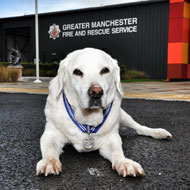
Labrador pair honoured for 10 years of outstanding service
Two dogs from Greater Manchester Fire and Rescue Service are set to receive the animal equivalent of an OBE, which recognises their courage and devotion throughout their 10-year careers.
Yellow Labradors, Echo and Cracker, aged 14 and 13 respectively, will receive the PDSA Order of Merit at a special ceremony in October.
Echo served as a search and rescue dog from 2004 to 2013, during which time he was deployed to work in Haiti after the 2010 earthquake, which devastated large parts of the country. The capital, Port-au-Prince, was buried under tonnes of collapsed buildings and structures.
Working in heat and humidity alongside a UN police envoy, Echo worked tirelessly for nearly two weeks, conducting 46 separate searches. Sadly, owing to the severity of the quake, everyone that Echo discovered had already died.
His handler Mike said: “I can honestly say that Haiti was hell on earth. The city’s infrastructure had been decimated. There were no hospitals – survivors were relying solely on aid from outside the country to help them.
“For Echo, the smell of death surrounded him. As a puppy, he was taught to search for the living, but as the situation was so bleak and desperate, his searches for survivors were fruitless. He helped us find victims buried deep within collapsed buildings - libraries and shopping centres…
“Echo and I shared a tent and I think we were both glad of each other to cuddle up to after each of those gruelling days. Those sights will stay with me forever and I will always be grateful to Echo for the strength and determination he showed while we were deployed.”
Meanwhile, Cracker worked as a fire service investigation dog for 10 years before she retired in February last year. Trained to detect 20 different types of accelerant, Cracker helped forensic teams to determine the cause of fires and secure convictions for suspected arsonists. During her career she was involved in many high profile cases, including serious assaults and a double murder.
All in all, she attended over 650 incidents, leading to more than 200 years of custodial sentences for arson-related crimes.
In one case, there had been a major explosion at a large detached building on War Office Road, Rochdale. Cracker was instructed to climb what was left of the staircase to search the upper floor, navigating a large hole in the floor and making her way through fallen beams and roofing material.
She tracked along the skirting board to a place outside the bathroom and gave a positive indication, which allowed the fire investigation team to confirm that the explosion was the result of arson.
In addition to her work at crime scenes, Cracker also visited schools to help educate young people in fire and home safety.
John Faulkner, principal vet at the PDSA, said: “Both Echo and Cracker have displayed incredible skill in their respective roles. Their stories are a true inspiration and we are all thrilled that they will be receiving the PDSA Order of Merit – known as the animal equivalent of the OBE.”
Image © PDSA

 BVA has announced a new series of its Building Great Workplaces lunchtime webinars.



