
Your data on MRCVSonline
The nature of the services provided by Vision Media means that we might obtain certain information about you.
Please read our Data Protection and Privacy Policy for details.

In addition, (with your consent) some parts of our website may store a 'cookie' in your browser for the purposes of
functionality or performance monitoring.
Click here to manage your settings.
If you would like to forward this story on to a friend, simply fill in the form below and click send.

Your friend's email:
Your email:
Your name:
 
 
Send Cancel

ASF risk level raised to medium in the UK
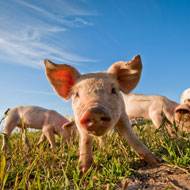
The risk of exposure to the UK’s pig population is still considered to be ‘low’.
Bulgaria reports first outbreak in backyard pigs

The risk of African swine fever (ASF) entering the UK via contaminated pig products has been raised to ‘medium’, following a recent upswing in outbreaks on commercial pig farms in Romania and Poland.

Bulgaria also reported its first outbreak in backyard pigs on 31 August. Four out of seven pigs died and the remainder were culled.

Several thousand tonnes of Romanian-origin meat per annum are consigned to the UK from EU member states.

According to the APHA’s latest risk assessment, the risk of exposure to the UK’s pig population is still considered to be ‘low’.

Since 22 August, Romania has seen 42 new outbreaks in several regions - four of which occurred on commercial pig farms with more than 140,000 pigs on affected premises.

Meanwhile, the disease was detected for the first time in China in early August. The country’s sixth outbreak, on a farm with 459 susceptible pigs, was reported on 31 August in Yanhe Village, Anhui. China’s agriculture ministry has introduced a ban on transporting pigs or pig products from provinces where ASF has been confirmed, and is set to shut down live pig markets in the region.

APHA will reassess the risk to the UK every two weeks. Pig keepers are reminded not to feed swill to their animals and to be aware that visitors to their premises should not have had any recent contact with affected regions.

ASF should be considered as a possible diagnosis, even in single pigs with haemorrhagic lesions, lethargy, skin discolouration or petechiation and high fever. Any suspected cases must be reported to APHA immediately.


 

Become a member or log in to add this story to your CPD history

Equine Disease Surveillance report released for Q4 2025

News Story 1
 The latest Equine Disease Surveillance report has been released, with details on equine disease from Q4 of 2025.

The report, produced by Equine Infectious Disease Surveillance, includes advice on rule changes for equine influenza vaccination.

Statistics and maps detail recent outbreaks of equine herpes virus, equine influenza, equine strangles and equine grass sickness. A series of laboratory reports provides data on virology, bacteriology, parasitology and toxicosis.

This issue also features a case study of orthoflavivus-associated neurological disease in a horse in the UK. 

Click here for more...
News Shorts
NSA webinar explores sheep tailing and castration

The National Sheep Association (NSA) is to host a free webinar on the castration and tail docking of lambs.

The webinar, 'Understanding the tailing and castration consultation: A guide for sheep farmers', will be hosted online on Monday, 2 March 2026 at 7.30pm.

It comes during a government consultation into the methods used for these procedures. Farmers are encouraged to engage before the consultation period closes on Monday, 9 March 2026.

The webinar offers clear and actionable guidance to support farmers to contribute meaningfully to the consultation and prepare for potential changes.

On the panel will be former SVS president Kate Hovers, farmer and vet Ann Van Eetvelt and SRUC professor in Animal Health and Veterinary Sciences Cathy Dwyer. Each panel member will utilise their own specialism and expertise to evaluate risks and outcomes to sheep farming.

Find out more about the webinar on the NSA website.

