
Your data on MRCVSonline
The nature of the services provided by Vision Media means that we might obtain certain information about you.
Please read our Data Protection and Privacy Policy for details.

In addition, (with your consent) some parts of our website may store a 'cookie' in your browser for the purposes of
functionality or performance monitoring.
Click here to manage your settings.
If you would like to forward this story on to a friend, simply fill in the form below and click send.

Your friend's email:
Your email:
Your name:
 
 
Send Cancel

Public urged to listen for tawny owls
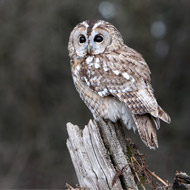
The survey aims to establish the impact of light pollution and urbanisation on tawny owl populations.
Survey launched to better understand species’ status
 
The British public is being urged to listen out for the familiar ‘hooting’ and ‘kee-wick’ calls of Tawny owls this autumn and winter, following concerns that the species may be in decline.

The British Trust for Ornithology (BTO) has launched the Tawny Owl Calling Survey in response to the species being moved to the Amber List of Birds of Conservation Concern. It calls on participants to listen out for tawny owls from their garden, local park or woodland between 30 September 2018 and 31 March 2019.

“The hooting or “twoo” sound is usually made by the male and is a territorial call,” researchers said on the BTO’s website. “You can sometimes hear a female responding to a male’s “twoo” call with a sharp “kee-wick”. Together this duet produces the classic “twit twoo” sound, which many people associate with these owls.”

Besides increasing understanding of tawny owl calling behaviour, the survey aims to establish the impact of light pollution and urbanisation on their populations. The data will build on information collected by more than 3,465 volunteers in 2005/06 when a similar survey found the time of day, moon cycle and weather impacted calling behaviour.

Claire Boothby, Survey Organiser at BTO, explained: "You can listen from pretty much anywhere you like for 20 minutes one evening a week. Anyone can take part, and the more people that do the better picture scientists at BTO will have of our Tawny Owls – you can even do it from the comfort of your bed."

For more information about the survey, visit the BTO website or email gbw@bto.org

Become a member or log in to add this story to your CPD history

Equine Disease Surveillance report released for Q4 2025

News Story 1
 The latest Equine Disease Surveillance report has been released, with details on equine disease from Q4 of 2025.

The report, produced by Equine Infectious Disease Surveillance, includes advice on rule changes for equine influenza vaccination.

Statistics and maps detail recent outbreaks of equine herpes virus, equine influenza, equine strangles and equine grass sickness. A series of laboratory reports provides data on virology, bacteriology, parasitology and toxicosis.

This issue also features a case study of orthoflavivus-associated neurological disease in a horse in the UK. 

Click here for more...
News Shorts
NSA webinar explores sheep tailing and castration

The National Sheep Association (NSA) is to host a free webinar on the castration and tail docking of lambs.

The webinar, 'Understanding the tailing and castration consultation: A guide for sheep farmers', will be hosted online on Monday, 2 March 2026 at 7.30pm.

It comes during a government consultation into the methods used for these procedures. Farmers are encouraged to engage before the consultation period closes on Monday, 9 March 2026.

The webinar offers clear and actionable guidance to support farmers to contribute meaningfully to the consultation and prepare for potential changes.

On the panel will be former SVS president Kate Hovers, farmer and vet Ann Van Eetvelt and SRUC professor in Animal Health and Veterinary Sciences Cathy Dwyer. Each panel member will utilise their own specialism and expertise to evaluate risks and outcomes to sheep farming.

Find out more about the webinar on the NSA website.


