
Your data on MRCVSonline
The nature of the services provided by Vision Media means that we might obtain certain information about you.
Please read our Data Protection and Privacy Policy for details.

In addition, (with your consent) some parts of our website may store a 'cookie' in your browser for the purposes of
functionality or performance monitoring.
Click here to manage your settings.
If you would like to forward this story on to a friend, simply fill in the form below and click send.

Your friend's email:
Your email:
Your name:
 
 
Send Cancel

Call for vets and farmers to work together on medicine storage
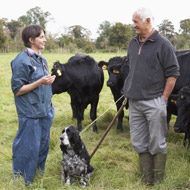
Vets and farmers are being urged to work together on medicine storage.
Study sheds light on storage facilities on UK dairy farms

Researchers at the University of Bristol are calling on veterinary surgeons in the UK to work with farmers to remove expired and inappropriate medicines from farms and dispose of them appropriately.

Writing in Vet Record, the researchers describe a study in which they investigated medicine storage facilities on UK dairy farms. They found that while most farmers are storing their medicines appropriately, there is still room for improvement.

The study examined medicines stored on 27 farms in South West England and South Wales between September 2016 and October 2017. The most significant findings from the research were:

  • most farms stored medicines in designated, lockable medicine cupboards
  • there was a large variation in the quantity and types of antibiotics stored on farms
  • highest priority critically important antimicrobials were found on 90 per cent of farms
  • expired medicines, including antibiotics, were commonly found on farms
  • medicines not licensed for use in dairy cattle were found on some farms. 
     
Researchers say that incorporating a medicine cupboard ‘health check’ into the routine annual herd health review would help to bring about improvement. The call is supported by the British Cattle Veterinary Association, the British Veterinary Association and the Responsible Use of Medicines in Agriculture.

"Our study has shown that most farmers are storing their medicines appropriately, but that there is variation between farms,” said Gwen Rees, Langford Trust, PhD scholar at Bristol Veterinary School. “This highlights just how important it is for veterinary surgeons to prescribe appropriately and help farmers ensure that the right animals are getting the right medicines.

"There is a need for open conversations - as part of routine health planning - around the use of expired medicines, medicines used under Cascade and the use of critically important antimicrobials, particularly in the current climate of increasing awareness of the global threat of antibiotic resistance."


Become a member or log in to add this story to your CPD history

Equine Disease Surveillance report released for Q4 2025

News Story 1
 The latest Equine Disease Surveillance report has been released, with details on equine disease from Q4 of 2025.

The report, produced by Equine Infectious Disease Surveillance, includes advice on rule changes for equine influenza vaccination.

Statistics and maps detail recent outbreaks of equine herpes virus, equine influenza, equine strangles and equine grass sickness. A series of laboratory reports provides data on virology, bacteriology, parasitology and toxicosis.

This issue also features a case study of orthoflavivus-associated neurological disease in a horse in the UK. 

Click here for more...
News Shorts
NSA webinar explores sheep tailing and castration

The National Sheep Association (NSA) is to host a free webinar on the castration and tail docking of lambs.

The webinar, 'Understanding the tailing and castration consultation: A guide for sheep farmers', will be hosted online on Monday, 2 March 2026 at 7.30pm.

It comes during a government consultation into the methods used for these procedures. Farmers are encouraged to engage before the consultation period closes on Monday, 9 March 2026.

The webinar offers clear and actionable guidance to support farmers to contribute meaningfully to the consultation and prepare for potential changes.

On the panel will be former SVS president Kate Hovers, farmer and vet Ann Van Eetvelt and SRUC professor in Animal Health and Veterinary Sciences Cathy Dwyer. Each panel member will utilise their own specialism and expertise to evaluate risks and outcomes to sheep farming.

Find out more about the webinar on the NSA website.

