
Your data on MRCVSonline
The nature of the services provided by Vision Media means that we might obtain certain information about you.
Please read our Data Protection and Privacy Policy for details.

In addition, (with your consent) some parts of our website may store a 'cookie' in your browser for the purposes of
functionality or performance monitoring.
Click here to manage your settings.
If you would like to forward this story on to a friend, simply fill in the form below and click send.

Your friend's email:
Your email:
Your name:
 
 
Send Cancel

Rescue seals named after royal couple
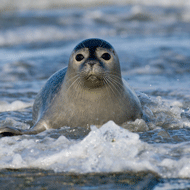
The rescue centre urged the public to show ‘decorum’ when it comes to animals found on the beach.
Meghan Mackerel and Prince Herring were born prematurely 

A pair of rescued seals have been named ‘Prince Herring’ and ‘Meghan Mackerel’, in honour of the royal couple Prince Harry and Meghan Markle.

The seals (not pictured) were rescued separately in June by Vancouver Aquarium Marine Mammal Rescue Centre, where they now reside. Meghan Mackerel was found alone on Sidney Island near Victoria on June 18, with no sign of her mother.

She was underweight, had remnants of her umbilical cord still attached and was still covered in soft fur, suggesting she was born prematurely.

Prince Herring was also born prematurely and was found two days later in a marsh located inland from Crescent Beach. He was still attached to the placenta but his mother was nowhere in sight.

In a statement, the rescue centre urged the public to show ‘decorum’ when it comes to animals found on the beach.

Assistant manager Emily Johnson said: "Mothers will often leave their pups on shore while they forage for food; they will usually make it back. We ask those who find a seal pup not to touch it and to keep their pets away. Call us, we'll assess the animal, then decide if a rescue is needed."

Members of the public can symbolically ‘adopt’ Meghan or Herring to help fund ongoing rehabilitation efforts at the centre, which rescues, rehabilitates and releases around 150 animals a year.


Become a member or log in to add this story to your CPD history

Submissions open for BSAVA Clinical Research Abstracts 2026

News Story 1
 The BSAVA has opened submissions for the BSAVA Clinical Research Abstracts 2026.

It is an opportunity for applicants to present new research on any veterinary subject, such as the preliminary results of a study, discussion of a new technique or a description of an interesting case.

They must be based on high-quality clinical research conducted in industry, practice or academia, and summarised in 250 words.

Applications are welcome from vets, vet nurses, practice managers, and students.

Submissions are open until 6 March 2026. 

Click here for more...
News Shorts
Survey seeks ruminant sector views on antimicrobial stewardship

A new survey is seeking views of people working in the UK ruminant sector on how to tackle the challenge of demonstrating responsible antibiotic stewardship.

Forming part of a wider, collaborative initiative, the results will help identify the types of data available so that challenges with data collection can be better understood and addressed.

Anyone working in the UK farming sector, including vets and farmers,is encouraged to complete the survey, which is available at app.onlinesurveys.jisc.ac.uk

