
Your data on MRCVSonline
The nature of the services provided by Vision Media means that we might obtain certain information about you.
Please read our Data Protection and Privacy Policy for details.

In addition, (with your consent) some parts of our website may store a 'cookie' in your browser for the purposes of
functionality or performance monitoring.
Click here to manage your settings.
If you would like to forward this story on to a friend, simply fill in the form below and click send.

Your friend's email:
Your email:
Your name:
 
 
Send Cancel

Prison adopts 200 hens destined for slaughter
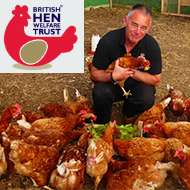
Wayne Walters, a livestock and project management instructional officer, launched Project Jail Bird to help the men cope with life in prison.

British Hen Welfare Trust delivers hens for Project Jail Bird

A prison in Dorset has adopted 200 hens that would otherwise have been sent to slaughter, as part of a new initiative to help prisoners.

HMP Guys Marsh is a Category C prison that holds up to 450 men, some of whom have committed serious crimes.

Wayne Walters, a livestock and project management instructional officer, launched Project Jail Bird to help the men cope with life in prison, as well as aiding their rehabilitation and release.

With the help of Prisoner J (who cannot be named for legal reasons), Wayne transformed an unused area of the prison into a haven for the hens. It is complete with handmade flower boxes crafted by the prisoners, which sit on the outside of a newly erected coop.

The hens had previously been living on a commercial farm laying eggs to be sold in supermarkets, or to be put into processed foods. At 18 months, they had reached the end of their commercial life and would have faced slaughter had they not been rescued by the British Hen Welfare Trust.

Jane Howorth, MBE and founder of the trust, personally delivered the birds to Guys Marsh with the charity’s head of operations, Gaynor Davies.

She said: “What really struck me was the effort that both Wayne and Prisoner J had put into Project Jail Bird. They have created a fantastic facility for hens out of wasted space, and in so doing given the prisoners at Guys Marsh the opportunity to learn new skills, and of course given the hens a wonderful second chance in life.  

“The charity has supplied hens to almost a dozen prisons across the UK and I wholeheartedly support Wayne’s initiative seeing only benefit in rolling out the model across all UK prisons.”

Image (c) British Hen Welfare Trust

 

Become a member or log in to add this story to your CPD history

Equine Disease Surveillance report released for Q4 2025

News Story 1
 The latest Equine Disease Surveillance report has been released, with details on equine disease from Q4 of 2025.

The report, produced by Equine Infectious Disease Surveillance, includes advice on rule changes for equine influenza vaccination.

Statistics and maps detail recent outbreaks of equine herpes virus, equine influenza, equine strangles and equine grass sickness. A series of laboratory reports provides data on virology, bacteriology, parasitology and toxicosis.

This issue also features a case study of orthoflavivus-associated neurological disease in a horse in the UK. 

Click here for more...
News Shorts
NSA webinar explores sheep tailing and castration

The National Sheep Association (NSA) is to host a free webinar on the castration and tail docking of lambs.

The webinar, 'Understanding the tailing and castration consultation: A guide for sheep farmers', will be hosted online on Monday, 2 March 2026 at 7.30pm.

It comes during a government consultation into the methods used for these procedures. Farmers are encouraged to engage before the consultation period closes on Monday, 9 March 2026.

The webinar offers clear and actionable guidance to support farmers to contribute meaningfully to the consultation and prepare for potential changes.

On the panel will be former SVS president Kate Hovers, farmer and vet Ann Van Eetvelt and SRUC professor in Animal Health and Veterinary Sciences Cathy Dwyer. Each panel member will utilise their own specialism and expertise to evaluate risks and outcomes to sheep farming.

Find out more about the webinar on the NSA website.


