
Your data on MRCVSonline
The nature of the services provided by Vision Media means that we might obtain certain information about you.
Please read our Data Protection and Privacy Policy for details.

In addition, (with your consent) some parts of our website may store a 'cookie' in your browser for the purposes of
functionality or performance monitoring.
Click here to manage your settings.
If you would like to forward this story on to a friend, simply fill in the form below and click send.

Your friend's email:
Your email:
Your name:
 
 
Send Cancel

Government updates guidance on movement of horses
Owners will need to consult with a vet at least six weeks before they are planning to travel.

Guidance designed to help owners in a no-deal scenario

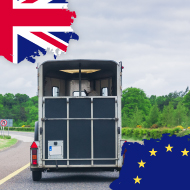
The Government has updated its guidance for owners on the movement of horses and other equines in the event of a no-deal Brexit.

The guidance is designed to give owners time to prepare for the new processes, and factor in extra travel time that be required when travelling to and from the EU.

“While the Government is seeking a deal, we have stepped up our preparations and we will be ready to leave the EU on 31 October, whatever the circumstances,” explained Defra minister Lord Gardiner.

“This guidance will help businesses and owners of horses prepare if we leave without a deal and the Government has already committed to the continued movement of horses from EU member states.”

If the UK leaves the EU on 31 October without a deal:

 • equines travelling from the UK to the EU may need to undergo additional blood tests, which will need to be carried out within 30 days or less of travelling to satisfy EU regulations
 • owners will need to consult with a vet at least six weeks before they are planning to travel
 • all equines will need an Export Health Certificate in order to travel to EU states, instead of current documents, and will need to enter the EU via a Border Inspection Post (BIP)
 • most equines will also need a Government-issued travel ID document, as well as their existing equine passport.

The UK has already committed to allow the continued movement of all equines from EU member states ahead of major equestrian events and to support the industries that rely on these animals.

The government is continuing with its application to the European Commission (EC) on securing listed status for the UK, which would enable the continued movement of equines to EU member states.

If the UK is not provided with listed status by the EC, equines will not be able to travel until listed status is secured. 

Become a member or log in to add this story to your CPD history

Equine Disease Surveillance report released for Q4 2025

News Story 1
 The latest Equine Disease Surveillance report has been released, with details on equine disease from Q4 of 2025.

The report, produced by Equine Infectious Disease Surveillance, includes advice on rule changes for equine influenza vaccination.

Statistics and maps detail recent outbreaks of equine herpes virus, equine influenza, equine strangles and equine grass sickness. A series of laboratory reports provides data on virology, bacteriology, parasitology and toxicosis.

This issue also features a case study of orthoflavivus-associated neurological disease in a horse in the UK. 

Click here for more...
News Shorts
NSA webinar explores sheep tailing and castration

The National Sheep Association (NSA) is to host a free webinar on the castration and tail docking of lambs.

The webinar, 'Understanding the tailing and castration consultation: A guide for sheep farmers', will be hosted online on Monday, 2 March 2026 at 7.30pm.

It comes during a government consultation into the methods used for these procedures. Farmers are encouraged to engage before the consultation period closes on Monday, 9 March 2026.

The webinar offers clear and actionable guidance to support farmers to contribute meaningfully to the consultation and prepare for potential changes.

On the panel will be former SVS president Kate Hovers, farmer and vet Ann Van Eetvelt and SRUC professor in Animal Health and Veterinary Sciences Cathy Dwyer. Each panel member will utilise their own specialism and expertise to evaluate risks and outcomes to sheep farming.

Find out more about the webinar on the NSA website.


