
Your data on MRCVSonline
The nature of the services provided by Vision Media means that we might obtain certain information about you.
Please read our Data Protection and Privacy Policy for details.

In addition, (with your consent) some parts of our website may store a 'cookie' in your browser for the purposes of
functionality or performance monitoring.
Click here to manage your settings.
If you would like to forward this story on to a friend, simply fill in the form below and click send.

Your friend's email:
Your email:
Your name:
 
 
Send Cancel

Vets save Labrador that ate over 30 gingerbread decorations
In total Marley needed two surgeries, which took over three hours.

PDSA warns pet owners of festive hazards for pets

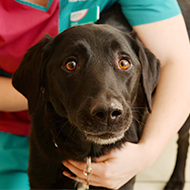
A seven-year-old Labrador named Marley needed life-saving surgery after eating over 30 home-made gingerbread Christmas tree decorations – including the ribbons attached to them – which caused a potentially fatal blockage.

Marley’s owner Rachael Bulmer (37), from Bournemouth, had been baking the decorations and left them to cool on the kitchen counter.

“I thought I’d left them safely out of reach,” she said, “but when I noticed some were gone I instantly knew who had taken them.

“Over the years Marley’s been no stranger to eating things he shouldn’t and usually they pass through. But this time he started acting strangely and looked like he was going into shock. He was violently sick and brought up some of the ribbon.”

She called PDSA Pet Hospital in Bournemouth, and was instructed to bring Marley in immediately. The dog was rushed into emergency surgery to remove the blockage.

During the procedure, it was also found that Marley had swallowed bones, which had become lodged in his stomach. Ultimately, it took a total of three hours and two operations for PDSA’s skilled veterinary team to remove all 34 ribbons from the dog’s stomach.

PDSA senior vet Aoife Clancy said: “It was a lengthy, high-risk surgery. Marley’s chances of surviving the night were looking poor, so he was transferred to the out-of-hours provider, Vets Now, so he could be cared for overnight. Thankfully he pulled through but needed critical round-the-clock care for four days before he could go home.”

Marley is now recovering at home on strict cage rest, his owners have thanked the PDSA veterinary team for their hard work and care.

PDSA is urging pet owners to ensure they keep festive food and decorations out of reach of pets this Christmas, and have released a Pet Survival Guide with further information.

Image (c) PDSA

Become a member or log in to add this story to your CPD history

Equine Disease Surveillance report released for Q4 2025

News Story 1
 The latest Equine Disease Surveillance report has been released, with details on equine disease from Q4 of 2025.

The report, produced by Equine Infectious Disease Surveillance, includes advice on rule changes for equine influenza vaccination.

Statistics and maps detail recent outbreaks of equine herpes virus, equine influenza, equine strangles and equine grass sickness. A series of laboratory reports provides data on virology, bacteriology, parasitology and toxicosis.

This issue also features a case study of orthoflavivus-associated neurological disease in a horse in the UK. 

Click here for more...
News Shorts
NSA webinar explores sheep tailing and castration

The National Sheep Association (NSA) is to host a free webinar on the castration and tail docking of lambs.

The webinar, 'Understanding the tailing and castration consultation: A guide for sheep farmers', will be hosted online on Monday, 2 March 2026 at 7.30pm.

It comes during a government consultation into the methods used for these procedures. Farmers are encouraged to engage before the consultation period closes on Monday, 9 March 2026.

The webinar offers clear and actionable guidance to support farmers to contribute meaningfully to the consultation and prepare for potential changes.

On the panel will be former SVS president Kate Hovers, farmer and vet Ann Van Eetvelt and SRUC professor in Animal Health and Veterinary Sciences Cathy Dwyer. Each panel member will utilise their own specialism and expertise to evaluate risks and outcomes to sheep farming.

Find out more about the webinar on the NSA website.


