
Your data on MRCVSonline
The nature of the services provided by Vision Media means that we might obtain certain information about you.
Please read our Data Protection and Privacy Policy for details.

In addition, (with your consent) some parts of our website may store a 'cookie' in your browser for the purposes of
functionality or performance monitoring.
Click here to manage your settings.
If you would like to forward this story on to a friend, simply fill in the form below and click send.

Your friend's email:
Your email:
Your name:
 
 
Send Cancel

BVA reiterates call for tighter restrictions on pet travel
The Government has "no immediate plans" to change its recommendations on pet travel.

Association appeals to government to reexamine the evidence

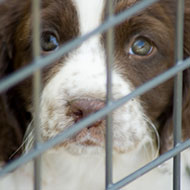
Following the Government’s response to the Efra Select Committee report on tackling illegal puppy smuggling, the British Veterinary Association (BVA) has reiterated its call for tighter restrictions on pet travel and improved disease controls.

Defra minister Zac Goldsmith has written to the Committee answering a series of questions and recommendations on strengthening rules. The Efra Committee praised Defra’s new ‘Petfished’ campaign but expressed concerns that some of the recommendations have not been taken into account.

In its submissions to the Efra enquiry, the BVA called for a raise on the minimum age requirement for puppy travel from 15 weeks to six months. The Association said this would lessen the chance of puppies arriving into the UK at a saleable age.


Lord Goldsmith stated in his response, however, that the Government “has no immediate plans” to change its recommendations on pet travel.

Commenting, BVA president Daniella Dos Santos said: “This is such a missed opportunity for meaningful action to clamp down illegal puppy smuggling and improve disease controls. It’s far too easy for organised criminals to bring puppies into the UK for sale by abusing the current pet travel controls.

“EU Exit has provided an opportunity to strengthen our rules and only allow puppies to enter the UK at an age where they can no longer be advertised as cute puppies. It’s deeply disappointing that Defra isn’t considering taking this action."

She continued: “Vets see the heartache that can result from poorly bred and badly socialised puppies being illegally imported and sold to unsuspecting families. Awareness campaigns are important and useful but we also need strong regulatory measures that will stop the problem coming into the country. We’re appealing to the Government to look again at the evidence.”


Become a member or log in to add this story to your CPD history

Equine Disease Surveillance report released for Q4 2025

News Story 1
 The latest Equine Disease Surveillance report has been released, with details on equine disease from Q4 of 2025.

The report, produced by Equine Infectious Disease Surveillance, includes advice on rule changes for equine influenza vaccination.

Statistics and maps detail recent outbreaks of equine herpes virus, equine influenza, equine strangles and equine grass sickness. A series of laboratory reports provides data on virology, bacteriology, parasitology and toxicosis.

This issue also features a case study of orthoflavivus-associated neurological disease in a horse in the UK. 

Click here for more...
News Shorts
NSA webinar explores sheep tailing and castration

The National Sheep Association (NSA) is to host a free webinar on the castration and tail docking of lambs.

The webinar, 'Understanding the tailing and castration consultation: A guide for sheep farmers', will be hosted online on Monday, 2 March 2026 at 7.30pm.

It comes during a government consultation into the methods used for these procedures. Farmers are encouraged to engage before the consultation period closes on Monday, 9 March 2026.

The webinar offers clear and actionable guidance to support farmers to contribute meaningfully to the consultation and prepare for potential changes.

On the panel will be former SVS president Kate Hovers, farmer and vet Ann Van Eetvelt and SRUC professor in Animal Health and Veterinary Sciences Cathy Dwyer. Each panel member will utilise their own specialism and expertise to evaluate risks and outcomes to sheep farming.

Find out more about the webinar on the NSA website.

