


African swine fever confirmed in India
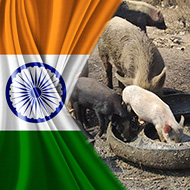
A quarter of the global pig population is estimated to die as a result of ASF.
African swine fever (ASF) has been detected in India for the first time.
According to the National Pig Association (NPA), the disease was detected in two north-eastern states: Assam, where it has already killed 2,500 pigs, and Arunachal Pradesh.
The Telegraph (India), reports that the Assam state government decided to send samples for testing after pigs failed to recover from vaccination against classical swine fever.
Results confirmed that all the 17 tissue samples from Assam were positive for ASF virus genome by real-time PCR and nucleotide sequencing analysis. A further 11 out of 62 samples from Arunachal Pradesh also tested positive for the ASF virus.
While movement restrictions have been introduced in Assam, authorities have collectively decided against culling pigs.
Assam's animal husbandry minister Atul Bora told India's Economic Times: "The National Institute of High-Security Animal Diseases (NIHSAD), Bhopal, has confirmed that it is African Swine Fever (ASF). The central government has informed us that it is the first instance of the disease in the country.
"We have discussed with experts if we can save the pigs without culling them. The death percentage of the pigs affected by the disease is almost 100 per cent. So we have made some strategies to save the pigs, which are not affected by the virus."
He continued: “After testing, we will cull only those pigs which will be found infected. We are avoiding the immediate culling of the pigs. We will have daily updates and take a decision as and when the situation demands."
ASF continues to devastate pig herds across the globe. Historically, outbreaks have been reported across Africa and parts of Europe, South America and the Caribbean. In recent years, however, the disease has devastated pig populations across much of Asia, Africa and parts of Europe.
ASF was confirmed in April on the Pacific island of Papua New Guinea. A quarter of the global pig population is estimated to die as a result of the disease.


 Defra has published guidance for the vet sector ahead of a proposed UK-EU Sanitary and Phytosanitary agreement.



