
Your data on MRCVSonline
The nature of the services provided by Vision Media means that we might obtain certain information about you.
Please read our Data Protection and Privacy Policy for details.

In addition, (with your consent) some parts of our website may store a 'cookie' in your browser for the purposes of
functionality or performance monitoring.
Click here to manage your settings.
If you would like to forward this story on to a friend, simply fill in the form below and click send.

Your friend's email:
Your email:
Your name:
 
 
Send Cancel

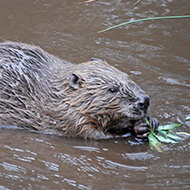
Conservationists express delight at beaver trial success
Beavers were hunted to extinction in Britiain around 400 years ago.

Beavers introduced to the River Otter will be able to remain permanently. 

Wildlife conservationists have expressed their delight at the successful completion of a trial to reintroduce beavers to the wild.

The government hailed the five-year beaver trial on the River Otter in Devon a success. The beavers will now be able to remain in the river permanently and naturally expand their range.

Peter Burgess, director of conservation at Devon Wildlife Trust, described the government's decision as “the most ground-breaking" for England's wildlife for a generation.

“Beavers are nature’s engineers and have the unrivalled ability to breathe new life into our rivers. Their benefits will be felt throughout our countryside, by wildlife and people,” he said.

The project started in 2015 when two family groups of beavers were successfully bred and dispersed throughout the River Otter. The catchment included up a total of 15 territories and 28 dams.

Defra reports that the trial has brought a wealth of benefits to the local area and ecology, including enhancing the environment at a local wildlife site, creating wetland habitat and reducing flood risk for housing downstream.
.
Environment minister Rebecca Pow said: “Thanks to the hard work of the Devon Wildlife Trust and their partners, the River Otter beavers reintroduction trial has proven highly successful - improving biodiversity and water quality, mitigating flooding and making the local landscape more resilient to climate change.

“We are firmly committed to providing opportunities to reintroduce formerly native species, such as beavers, where the benefits for the environment, people and the economy are clear.”

Once native to Britain, beavers were hunted to extinction around 400 years ago. The government is expected to consult on a strategy for the management of wild beavers - as well as further releases - later this year.


Become a member or log in to add this story to your CPD history

Equine Disease Surveillance report released for Q4 2025

News Story 1
 The latest Equine Disease Surveillance report has been released, with details on equine disease from Q4 of 2025.

The report, produced by Equine Infectious Disease Surveillance, includes advice on rule changes for equine influenza vaccination.

Statistics and maps detail recent outbreaks of equine herpes virus, equine influenza, equine strangles and equine grass sickness. A series of laboratory reports provides data on virology, bacteriology, parasitology and toxicosis.

This issue also features a case study of orthoflavivus-associated neurological disease in a horse in the UK. 

Click here for more...
News Shorts
NSA webinar explores sheep tailing and castration

The National Sheep Association (NSA) is to host a free webinar on the castration and tail docking of lambs.

The webinar, 'Understanding the tailing and castration consultation: A guide for sheep farmers', will be hosted online on Monday, 2 March 2026 at 7.30pm.

It comes during a government consultation into the methods used for these procedures. Farmers are encouraged to engage before the consultation period closes on Monday, 9 March 2026.

The webinar offers clear and actionable guidance to support farmers to contribute meaningfully to the consultation and prepare for potential changes.

On the panel will be former SVS president Kate Hovers, farmer and vet Ann Van Eetvelt and SRUC professor in Animal Health and Veterinary Sciences Cathy Dwyer. Each panel member will utilise their own specialism and expertise to evaluate risks and outcomes to sheep farming.

Find out more about the webinar on the NSA website.

