
Your data on MRCVSonline
The nature of the services provided by Vision Media means that we might obtain certain information about you.
Please read our Data Protection and Privacy Policy for details.

In addition, (with your consent) some parts of our website may store a 'cookie' in your browser for the purposes of
functionality or performance monitoring.
Click here to manage your settings.
If you would like to forward this story on to a friend, simply fill in the form below and click send.

Your friend's email:
Your email:
Your name:
 
 
Send Cancel

Animalcare achieves carbon neutral status
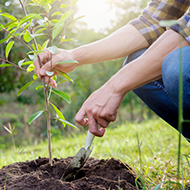
Animalcare aims to plant more than 200 native trees close to its headquarters.
Firm has successfully reduced its environmental impact by planting trees and conducting virtual meetings. 

Animalcare has announced that it has achieved carbon neutral status as part of its commitment to run a sustainable business.

The animal health firm began offsetting its carbon emissions earlier this year following a detailed assessment by Carbon Footprint Ltd. Among the steps already taken to reduce emissions include tree planting and embracing virtual meetings.

“Our responsibility as an animal health company extends beyond helping our veterinary colleagues to care for sick and vulnerable animals,” commented Animalcare product manager Kai Crawshaw. “We also take our responsibility to the environment, both at home and globally, very seriously.”

Animalcare's carbon emissions assessment revealed that some of its highest carbon-emitting activities concerned business travel. While this has been reduced as a result of COVID-19, the company plans to continue its use of virtual meetings once travel restrictions are lifted.

To further support a reduction of carbon in the atmosphere in the UK, Animalcare is participating in the Brazil Verified Carbon Standard REED project, an initiative that aims to prevent unplanned deforestation in the Amazon Rainforest. The firm also plans to plant more than 200 native British broad-leaved trees at a venue close to its headquarters later this year.

“As some aspects of our work, for instance, the packaging of our products, are governed by regulation so, beyond our direct control, we are focusing strongly on what we actually can do to make a difference,” Kai Crawshaw added. “We have already taken steps to reduce and offset our carbon emissions and are looking forward to helping to improve our local environment by planting more trees.”

Become a member or log in to add this story to your CPD history

Equine Disease Surveillance report released for Q4 2025

News Story 1
 The latest Equine Disease Surveillance report has been released, with details on equine disease from Q4 of 2025.

The report, produced by Equine Infectious Disease Surveillance, includes advice on rule changes for equine influenza vaccination.

Statistics and maps detail recent outbreaks of equine herpes virus, equine influenza, equine strangles and equine grass sickness. A series of laboratory reports provides data on virology, bacteriology, parasitology and toxicosis.

This issue also features a case study of orthoflavivus-associated neurological disease in a horse in the UK. 

Click here for more...
News Shorts
NSA webinar explores sheep tailing and castration

The National Sheep Association (NSA) is to host a free webinar on the castration and tail docking of lambs.

The webinar, 'Understanding the tailing and castration consultation: A guide for sheep farmers', will be hosted online on Monday, 2 March 2026 at 7.30pm.

It comes during a government consultation into the methods used for these procedures. Farmers are encouraged to engage before the consultation period closes on Monday, 9 March 2026.

The webinar offers clear and actionable guidance to support farmers to contribute meaningfully to the consultation and prepare for potential changes.

On the panel will be former SVS president Kate Hovers, farmer and vet Ann Van Eetvelt and SRUC professor in Animal Health and Veterinary Sciences Cathy Dwyer. Each panel member will utilise their own specialism and expertise to evaluate risks and outcomes to sheep farming.

Find out more about the webinar on the NSA website.

