


Study highlights equid welfare in Nepalese brick kilns
"Working animals have a critical role to play in human livelihoods".
A new paper exploring the welfare of working equids in Nepalese brick kilns has been published in the journal, Animals.
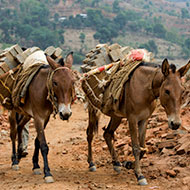
The Donkey Sanctuary-led study focused on the conditions that mules, donkeys and horses face while working in Nepalese brick kilns. Researchers hope their findings can be used to better understand how to improve equine welfare.
Zoe Raw, head of global research at The Donkey Sanctuary, said: “Working donkeys and mules are the backbone of rural economies across the world, providing people with a means to earn a living, transport goods, collect water or enable their children to access education.
“In Nepal, working donkeys and mules play a critical role; owners rely on their donkeys and mules to transport bricks within the brick kilns in order to earn a living and to feed their families. This piece of research provides robust, scientific evidence to demonstrate the value that working donkeys and mules provide to impoverished communities in Nepal, and demonstrates the critical role that good welfare plays in these micro-economies.”
The study employed the Equid Assessment, Research and Scoping (EARS) tool alongside Welfare Aggregation and Guidance (WAG) scoring to highlight the issues most negatively influencing equid welfare.
It found that the handler's attitude towards their equid has an impact on its welfare conditions. The researchers suggest implementing training programmes, specifically focusing on the impacts of harmful practices such as hobbling or tethering.
Stuart Norris, a senior statistician at The Donkey Sanctuary, said: “The paper provides the most detailed account of equid welfare and a fantastic baseline dataset in which to build strategies for improving the welfare of equids working in the brick kilns of Nepal.
“The use of the EARS tool, incorporating both the WAG tool and further analysis to understand the handlers’ impact on the welfare of equids, provides a robust monitoring tool to measure any future interventions.”
Zoe concluded: “Working animals have a critical role to play in human livelihoods and in development, and we look forward to seeing wider adoption of robust research techniques to help working animals and people in a more meaningful and impactful way.”


 Defra has published guidance for the vet sector ahead of a proposed UK-EU Sanitary and Phytosanitary agreement.



