Your data on MRCVSonline
The nature of the services provided by Vision Media means that we might obtain certain information about you.
Please read our Data Protection and Privacy Policy for details.

In addition, (with your consent) some parts of our website may store a 'cookie' in your browser for the purposes of
functionality or performance monitoring.
Click here to manage your settings.
If you would like to forward this story on to a friend, simply fill in the form below and click send.

Your friend's email:
Your email:
Your name:
 
 
Send Cancel

Study reveals growth charts for puppies could help tackle obesity
"The results of this study suggest that these growth charts can identify healthy growth [and] possible health problems." - Prof Alex German.

New evidence-based growth standards developed for vets and owners

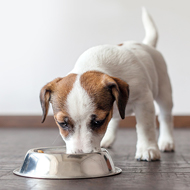
New research has suggested that the use of growth charts for puppies, similar the those used by humans, could help veterinary surgeons and pet owners to combat the ongoing canine obesity problem.

The research published in the journal PLOS One – was conducted by researchers from the University of Liverpool, Waltham Petcare Science Institute, Banfield Pet Hospital, and UCL Great Ormond Street Institute of Child Health.

The team created multiple evidence-based growth charts, based on bodyweight, for dogs across five different size categories. They then compared the growth curves presented by this set of standards with the patterns of growth in dogs that were healthy, had abnormal body condition, or had various diseases known to be associated with abnormal growth.

The results showed that 68 per cent of dogs that developed obesity by three years old gained weight faster than the growth standards predicted. However, 49 per cent of dogs that became underweight by three years old gained weight more slowly than what was expected.

Alex German, professor of small animal medicine at the University of Liverpool, said: “We know optimal growth is crucial for the future health and wellbeing of dogs, as many of the health issues that appear during early life are associated with poor weight management.

“The results of this study suggest that these growth charts can identify healthy growth as well as patterns of growth signalling possible health problems.

“We hope that veterinarians and owners will find these evidence-based growth standards easy to use, helping puppies to keep in shape and starting them on the right path for their adult life.”

To view the growth charts please visit the Waltham Petcare Science Institute's website.

Become a member or log in to add this story to your CPD history

Equine Disease Surveillance report released for Q4 2025

News Story 1
 The latest Equine Disease Surveillance report has been released, with details on equine disease from Q4 of 2025.

The report, produced by Equine Infectious Disease Surveillance, includes advice on rule changes for equine influenza vaccination.

Statistics and maps detail recent outbreaks of equine herpes virus, equine influenza, equine strangles and equine grass sickness. A series of laboratory reports provides data on virology, bacteriology, parasitology and toxicosis.

This issue also features a case study of orthoflavivus-associated neurological disease in a horse in the UK. 

Click here for more...
News Shorts
NSA webinar explores sheep tailing and castration

The National Sheep Association (NSA) is to host a free webinar on the castration and tail docking of lambs.

The webinar, 'Understanding the tailing and castration consultation: A guide for sheep farmers', will be hosted online on Monday, 2 March 2026 at 7.30pm.

It comes during a government consultation into the methods used for these procedures. Farmers are encouraged to engage before the consultation period closes on Monday, 9 March 2026.

The webinar offers clear and actionable guidance to support farmers to contribute meaningfully to the consultation and prepare for potential changes.

On the panel will be former SVS president Kate Hovers, farmer and vet Ann Van Eetvelt and SRUC professor in Animal Health and Veterinary Sciences Cathy Dwyer. Each panel member will utilise their own specialism and expertise to evaluate risks and outcomes to sheep farming.

Find out more about the webinar on the NSA website.