Your data on MRCVSonline
The nature of the services provided by Vision Media means that we might obtain certain information about you.
Please read our Data Protection and Privacy Policy for details.

In addition, (with your consent) some parts of our website may store a 'cookie' in your browser for the purposes of
functionality or performance monitoring.
Click here to manage your settings.
If you would like to forward this story on to a friend, simply fill in the form below and click send.

Your friend's email:
Your email:
Your name:
 
 
Send Cancel

Vets save cocker spaniel after it eats a face mask
Ralph had always had a liking for socks, but owner Julie Veidman never thought he'd eat a face mask.

Dog given emergency surgery to clear intestinal blockage

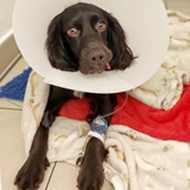
Veterinary staff at Huyton PDSA Pet Hospital had to perform emergency surgery on a one-year-old cocker spaniel named Ralph, after the animal ate a face mask.

Ralph's owner Julie Veidman woke one morning to find that her dog had vomited in the night. While not immediately concerned she became worried when Ralph could not keep water down and refused treats. She called PDSA straight away and was instructed to bring Ralph to the charity's pet hospital in Huyton.

“We examined Ralph and could feel something in his tummy – with his other symptoms we immediately suspected he’d eaten something he shouldn’t,” said veterinary surgeon Lizzie Whitton.

“An x-ray confirmed that there was some kind of blockage in his intestines. This can quickly become fatal, so we took him straight into emergency surgery.”

Ms Veidman, who is had to leave her job as a sales assistant due to the stresses caused by the pandemic, had an anxious wait at home while she awaited news.

“Walking away from the Pet Hospital holding his empty lead was one of the hardest things I’ve ever done,” she said. “He's been my absolute rock through lockdown, I don’t know what we [would do] without him.”

Ms Whitton continued: “Any type of surgery carries risk, and intestinal procedures can come with additional complications, but thankfully Ralph’s operation went very well. However we were all shocked when we removed a face mask from inside him!”

Ralph returned home soon afterwards and after two weeks he has made a complete recovery. Owner Julie thanked PDSA's veterinary team and added: “It worries me as you see masks discarded all over the place right now, and Ralph is living proof that dogs might eat them and suffer serious consequences.”

Images (c) PDSA.

Become a member or log in to add this story to your CPD history

Equine Disease Surveillance report released for Q4 2025

News Story 1
 The latest Equine Disease Surveillance report has been released, with details on equine disease from Q4 of 2025.

The report, produced by Equine Infectious Disease Surveillance, includes advice on rule changes for equine influenza vaccination.

Statistics and maps detail recent outbreaks of equine herpes virus, equine influenza, equine strangles and equine grass sickness. A series of laboratory reports provides data on virology, bacteriology, parasitology and toxicosis.

This issue also features a case study of orthoflavivus-associated neurological disease in a horse in the UK. 

Click here for more...
News Shorts
NSA webinar explores sheep tailing and castration

The National Sheep Association (NSA) is to host a free webinar on the castration and tail docking of lambs.

The webinar, 'Understanding the tailing and castration consultation: A guide for sheep farmers', will be hosted online on Monday, 2 March 2026 at 7.30pm.

It comes during a government consultation into the methods used for these procedures. Farmers are encouraged to engage before the consultation period closes on Monday, 9 March 2026.

The webinar offers clear and actionable guidance to support farmers to contribute meaningfully to the consultation and prepare for potential changes.

On the panel will be former SVS president Kate Hovers, farmer and vet Ann Van Eetvelt and SRUC professor in Animal Health and Veterinary Sciences Cathy Dwyer. Each panel member will utilise their own specialism and expertise to evaluate risks and outcomes to sheep farming.

Find out more about the webinar on the NSA website.