
Your data on MRCVSonline
The nature of the services provided by Vision Media means that we might obtain certain information about you.
Please read our Data Protection and Privacy Policy for details.

In addition, (with your consent) some parts of our website may store a 'cookie' in your browser for the purposes of
functionality or performance monitoring.
Click here to manage your settings.
If you would like to forward this story on to a friend, simply fill in the form below and click send.

Your friend's email:
Your email:
Your name:
 
 
Send Cancel

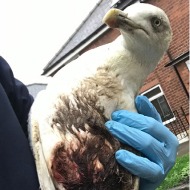
Seagull found with both feet severed by fishing line
The bird's feathers were covering in blood an dirt as it had been unable to get up off of the wet ground.

Charity issues reminder on dangers of fishing litter for wildlife

The RSPCA are urging those who enjoy fishing to ensure they dispose of their waste tackle and line carefully, after a seagull was found in a garden with both feet severed by fishing litter.

RSPCA inspector Claire Little responded to the call about the injured bird, which was trapped in a residential garden on Friday 20 November.

“The homeowner had spotted the bird trapped in her garden and was concerned about his welfare,” said Ms Little, “She said he was collapsed, couldn’t stand up and couldn’t fly. She could also see blood coming from his legs and said she thought his feet were missing.

“He couldn’t get out of the garden so I was able to catch him quite easily, which is never a good sign. As soon as I had hold of him it became clear what the problem was; he was missing both feet.

“They’d been severed off and he still had a small bit of fishing line twisted around the stubs, embedded very deeply in the skin.”

It was clear the bird couldn't survive in the wild and so the RSPCA were left with no choice but to euthanise the animal.

The charity – which receives around 3,000 calls each year about animals affected by angling litter – is urging fishermen to help prevent future casualties by following the Angling Trust’s Take 5 campaign and making use of the Anglers National Line Recycling Scheme to dispose of their waste tackle and line.

Image (c) RSPCA.

Become a member or log in to add this story to your CPD history

Equine Disease Surveillance report released for Q4 2025

News Story 1
 The latest Equine Disease Surveillance report has been released, with details on equine disease from Q4 of 2025.

The report, produced by Equine Infectious Disease Surveillance, includes advice on rule changes for equine influenza vaccination.

Statistics and maps detail recent outbreaks of equine herpes virus, equine influenza, equine strangles and equine grass sickness. A series of laboratory reports provides data on virology, bacteriology, parasitology and toxicosis.

This issue also features a case study of orthoflavivus-associated neurological disease in a horse in the UK. 

Click here for more...
News Shorts
NSA webinar explores sheep tailing and castration

The National Sheep Association (NSA) is to host a free webinar on the castration and tail docking of lambs.

The webinar, 'Understanding the tailing and castration consultation: A guide for sheep farmers', will be hosted online on Monday, 2 March 2026 at 7.30pm.

It comes during a government consultation into the methods used for these procedures. Farmers are encouraged to engage before the consultation period closes on Monday, 9 March 2026.

The webinar offers clear and actionable guidance to support farmers to contribute meaningfully to the consultation and prepare for potential changes.

On the panel will be former SVS president Kate Hovers, farmer and vet Ann Van Eetvelt and SRUC professor in Animal Health and Veterinary Sciences Cathy Dwyer. Each panel member will utilise their own specialism and expertise to evaluate risks and outcomes to sheep farming.

Find out more about the webinar on the NSA website.


