
Your data on MRCVSonline
The nature of the services provided by Vision Media means that we might obtain certain information about you.
Please read our Data Protection and Privacy Policy for details.

In addition, (with your consent) some parts of our website may store a 'cookie' in your browser for the purposes of
functionality or performance monitoring.
Click here to manage your settings.
If you would like to forward this story on to a friend, simply fill in the form below and click send.

Your friend's email:
Your email:
Your name:
 
 
Send Cancel

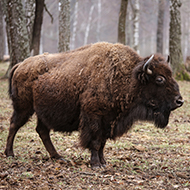
European bison returns from brink of extinction in IUCN Red List update
The European bison population has grown by more than 4,400 since 2003.

Conservation efforts ongoing as 31 species declared extinct

The International Union for Conservation of Nature (IUCN) has announced that the European bison has moved from Vulnerable to Near Threatened status in the latest update to the IUCN Red List of Threatened Species.

The European bison survived only in captivity throughout the early 20th Century, being reintroduced into the wild in the 1950s. Thanks to long-term conservation management, the wild population of the European bison has grown from 1,800 in 2003 to 6,200 in 2019.

According to IUCN, there are currently 47 free-ranging European bison herds, but only eight of them are large enough to be genetically viable in the long term.

Dr Rafał Kowalczyk, co-author of the new assessment and member of the IUCN SSC Bison Specialist Group said: “Historically, European bison were reintroduced mostly to forest habitats, where they don’t find enough food in winter.

“However, when they move out of the forest into agricultural areas, they often find themselves in conflict with people. To reduce the conflict risk and the bison’s dependence on supplementary feeding, it will be important to create protected areas that include open meadows for them to graze.”

The latest update also saw 31 species move into the Extinct category and all of the planet's freshwater dolphin species are now threatened with extinction.

IUCN director general Dr Bruno Oberle said: “The European bison and 25 other species recoveries documented in today’s IUCN Red List update demonstrate the power of conservation.

“Yet the growing list of Extinct species is a stark reminder that conservation efforts must urgently expand. To tackle global threats such as unsustainable fisheries, land clearing for agriculture, and invasive species, conservation needs to happen around the world and be incorporated into all sectors of the economy.”


Become a member or log in to add this story to your CPD history

Equine Disease Surveillance report released for Q4 2025

News Story 1
 The latest Equine Disease Surveillance report has been released, with details on equine disease from Q4 of 2025.

The report, produced by Equine Infectious Disease Surveillance, includes advice on rule changes for equine influenza vaccination.

Statistics and maps detail recent outbreaks of equine herpes virus, equine influenza, equine strangles and equine grass sickness. A series of laboratory reports provides data on virology, bacteriology, parasitology and toxicosis.

This issue also features a case study of orthoflavivus-associated neurological disease in a horse in the UK. 

Click here for more...
News Shorts
NSA webinar explores sheep tailing and castration

The National Sheep Association (NSA) is to host a free webinar on the castration and tail docking of lambs.

The webinar, 'Understanding the tailing and castration consultation: A guide for sheep farmers', will be hosted online on Monday, 2 March 2026 at 7.30pm.

It comes during a government consultation into the methods used for these procedures. Farmers are encouraged to engage before the consultation period closes on Monday, 9 March 2026.

The webinar offers clear and actionable guidance to support farmers to contribute meaningfully to the consultation and prepare for potential changes.

On the panel will be former SVS president Kate Hovers, farmer and vet Ann Van Eetvelt and SRUC professor in Animal Health and Veterinary Sciences Cathy Dwyer. Each panel member will utilise their own specialism and expertise to evaluate risks and outcomes to sheep farming.

Find out more about the webinar on the NSA website.

