
Your data on MRCVSonline
The nature of the services provided by Vision Media means that we might obtain certain information about you.
Please read our Data Protection and Privacy Policy for details.

In addition, (with your consent) some parts of our website may store a 'cookie' in your browser for the purposes of
functionality or performance monitoring.
Click here to manage your settings.
If you would like to forward this story on to a friend, simply fill in the form below and click send.

Your friend's email:
Your email:
Your name:
 
 
Send Cancel

Hundreds of birds found dead in Rome
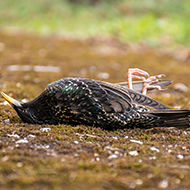
"It can be that they died from fear" - International Organization for the Protection of Animals.
Animal welfare campaigners say fireworks are to blame.

Animal welfare campaigners are calling for a ban on fireworks after hundreds of birds were found dead on the streets of Rome, Italy, on New Year's Day. 

Video footage circulating online shows the birds - many of which are starlings – lying on the ground near the city's Termini Train station. Although it is not exactly clear how the birds died, the International Organization for the Protection of Animals (OIPA) has attributed the deaths to fireworks.

A spokesperson for the organisation said: "It can be that they died from fear. They can fly up together and knock against each other, or hit windows or electric power lines. Let's not forget they can also die of heart attacks." 

The spokesperson added that fireworks cause stress and injury to wild birds and other animals - and the unusual amount of deaths occurred despite the city-wide ban on personal fireworks displays.

The OIPA is now calling for a complete ban on the sale of fireworks and firecrackers, but the RSPB says there is little evidence to suggest that fireworks harm wild birds or affect their conservation status. 

A statement on the RSBP's website reads: 'Available information suggests that the effect of firework displays on birds is little different from that of a thunderstorm. However, we will continue to monitor the situation and research to ensure the best course of action for wild bird conservation.

'Setting off fireworks close to nesting and roosting birds can cause disturbance. To minimise any adverse impact of fireworks on birds, we urge organisers of firework displays to avoid launching the rockets near to sensitive wildlife areas, such as nature reserves, and nesting and roosting sites for wild birds.'


Become a member or log in to add this story to your CPD history

Equine Disease Surveillance report released for Q4 2025

News Story 1
 The latest Equine Disease Surveillance report has been released, with details on equine disease from Q4 of 2025.

The report, produced by Equine Infectious Disease Surveillance, includes advice on rule changes for equine influenza vaccination.

Statistics and maps detail recent outbreaks of equine herpes virus, equine influenza, equine strangles and equine grass sickness. A series of laboratory reports provides data on virology, bacteriology, parasitology and toxicosis.

This issue also features a case study of orthoflavivus-associated neurological disease in a horse in the UK. 

Click here for more...
News Shorts
NSA webinar explores sheep tailing and castration

The National Sheep Association (NSA) is to host a free webinar on the castration and tail docking of lambs.

The webinar, 'Understanding the tailing and castration consultation: A guide for sheep farmers', will be hosted online on Monday, 2 March 2026 at 7.30pm.

It comes during a government consultation into the methods used for these procedures. Farmers are encouraged to engage before the consultation period closes on Monday, 9 March 2026.

The webinar offers clear and actionable guidance to support farmers to contribute meaningfully to the consultation and prepare for potential changes.

On the panel will be former SVS president Kate Hovers, farmer and vet Ann Van Eetvelt and SRUC professor in Animal Health and Veterinary Sciences Cathy Dwyer. Each panel member will utilise their own specialism and expertise to evaluate risks and outcomes to sheep farming.

Find out more about the webinar on the NSA website.

