


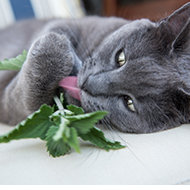
Study reveals insights into why cats go wild for catnip and silver vine.
Catnip, and the perhaps lesser-known plant silver vine, are renowned for sending cats into a frenzy. But new research, published in Science Advances, has revealed that attraction to the plants might be more practical than previously thought.
Until now, the reasons why cats have a euphoric response to catnip and silver vine were unknown. In this study, researchers at Iwate University, Nagoya University, Kyoto University, and the University of Liverpool set out to discover how the plants work and why cats respond in the way they do.
First, the group identified the active ingredient of silver vine that induces the euphoric response. After isolating substances from the extract of silver vine leaves, they administered each of them to cats to examine how they respond. The experiment revealed that the substance nepetalactone most strongly induces the characteristic behaviour.
Next, researchers looked at the biological response by feline animals to silver vine. They hypothesized that the plant activate the cat's opioid system, which is associated with euphoric effects in humans. Project leader Professor Masao Miyazaki of Iwate University said: "We tested β-endorphin levels before and after nepetalactol-induced response in cat blood. We found that silvervine activates the nervous system that is responsible for the euphorigenic reaction.”
Finally, the group set out to see if the biological response enables cats to transfer nepetalactone to their fur to protect against mosquitoes. This was based on previous research that showed nepetalactone (the feline attractant in catnip) can act as a mosquito repellant.
The team placed paper filters with nepetalactone on different parts of the cats' cages and found that when the cats rubbed against the paper, they transferred the substance to their faces and heads. This suggests that the most important function of rubbing is to apply the chemical to the fur.
Researchers then tested the mosquito repellent property of nepetalactone on cats by counting the numbers of mosquitoes that landed on their heads. They found that the mosquitoes landed less on the cats treated with nepetalactone.
Miyazaki explained: “To see whether mosquitoes react the same in a more natural setting, we compared the mosquito reaction between cats that responded to silver vine leaves and nonresponsive cats. Mosquitoes avoided the responsive cats. From these results, we found that the cats' reaction to silver vine is chemical defense against mosquitoes, and perhaps against viruses and parasitic insects. This was the most significant finding of our study.”


 BVA has announced a new series of its Building Great Workplaces lunchtime webinars.



