
Your data on MRCVSonline
The nature of the services provided by Vision Media means that we might obtain certain information about you.
Please read our Data Protection and Privacy Policy for details.

In addition, (with your consent) some parts of our website may store a 'cookie' in your browser for the purposes of
functionality or performance monitoring.
Click here to manage your settings.
If you would like to forward this story on to a friend, simply fill in the form below and click send.

Your friend's email:
Your email:
Your name:
 
 
Send Cancel

Charities call for Europe-wide ban on wild animals in circuses
"A Europe-wide ban is needed to free circus animals from their chains and cages, and end circus abuse in Europe once and for all." - Jan Creamer, ADI.

New campaign shows public support for 'reinvention' of circuses using animals.

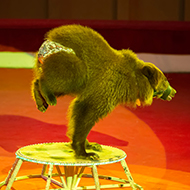
To mark World Wildlife Day, UK-based charity Animal Defenders International (ADI) and the Eurogroup for Animals coalition have launched a new campaign calling for a Europe-wide ban on the use of wild animals in circuses.

In the European Union, 23 member states have now adopted national restrictions on the use of animals in circuses; however, some nations’ restrictions only apply to certain species.

The EU Stop Circus Suffering campaign aims to raise awareness of the suffering that animals in circuses endure, in an effort to prompt authorities and governments around the world to end their use.

Investigations carried out by ADI have shown the poor conditions that animals in circuses are kept in, as well as the harsh handling methods used to control them and the excessive amounts of time they spend shut in trucks and trailers.

A Savanta ComRes opinion poll conducted on behalf of Eurogroup for Animals asked the public for their views on animals in circuses in Czech Republic, France, Germany, Hungary, Italy, Poland and Spain.

The results showed that 68 per cent of respondents agree that the use of wild animals in circuses is cruel and 62 per cent say that the European Union should ban the use of all wild animals in circuses. 83 per cent of respondents added that the European Union need to guarantee that cruel uses of animals are not allowed.

Jan Creamer, president of ADI said: “Many European nations have recognised that circuses are no place for wild animals and implemented bans.

“However, bans at the national and regional level have not stopped wild animals from being trucked around the continent in the name of cruel entertainment. A Europe-wide ban is needed to free circus animals from their chains and cages, and end circus abuse in Europe once and for all.”

ADI and Eurogroup for Animals will continue to raise awareness through the EU Stop Circus Suffering campaign over the coming months.


Become a member or log in to add this story to your CPD history

Equine Disease Surveillance report released for Q4 2025

News Story 1
 The latest Equine Disease Surveillance report has been released, with details on equine disease from Q4 of 2025.

The report, produced by Equine Infectious Disease Surveillance, includes advice on rule changes for equine influenza vaccination.

Statistics and maps detail recent outbreaks of equine herpes virus, equine influenza, equine strangles and equine grass sickness. A series of laboratory reports provides data on virology, bacteriology, parasitology and toxicosis.

This issue also features a case study of orthoflavivus-associated neurological disease in a horse in the UK. 

Click here for more...
News Shorts
NSA webinar explores sheep tailing and castration

The National Sheep Association (NSA) is to host a free webinar on the castration and tail docking of lambs.

The webinar, 'Understanding the tailing and castration consultation: A guide for sheep farmers', will be hosted online on Monday, 2 March 2026 at 7.30pm.

It comes during a government consultation into the methods used for these procedures. Farmers are encouraged to engage before the consultation period closes on Monday, 9 March 2026.

The webinar offers clear and actionable guidance to support farmers to contribute meaningfully to the consultation and prepare for potential changes.

On the panel will be former SVS president Kate Hovers, farmer and vet Ann Van Eetvelt and SRUC professor in Animal Health and Veterinary Sciences Cathy Dwyer. Each panel member will utilise their own specialism and expertise to evaluate risks and outcomes to sheep farming.

Find out more about the webinar on the NSA website.

