
Your data on MRCVSonline
The nature of the services provided by Vision Media means that we might obtain certain information about you.
Please read our Data Protection and Privacy Policy for details.

In addition, (with your consent) some parts of our website may store a 'cookie' in your browser for the purposes of
functionality or performance monitoring.
Click here to manage your settings.
If you would like to forward this story on to a friend, simply fill in the form below and click send.

Your friend's email:
Your email:
Your name:
 
 
Send Cancel

First wildcat arrives at Highlands breeding for release centre
It is hoped more cats will be introduced to the breeding for release centre in the coming months.

Nell is the first of 16 cats that will be prepared for life in the wild.

A Scottish wildcat has been introduced to Royal Zoological Society of Scotland's (RZSS) Highland Wildlife Park in a bid to save the elusive species from extinction. 

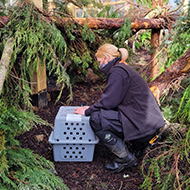
Young female Nell is the first Scottish Wildcat to be introduced to the Park's 'breeding for release' centre - an off-show centre, which provides breeding space, veterinary care, remote monitoring and training to prepare cats for life in the wild.

Nell arrived from Alladale Wilderness Reserve earlier this month and is said to be settling in well. Conservationists hope any kittens she rears will be among the first cats to be released into the Scottish Highlands next year, as part of a project to restore the critically endangered-species in Scotland.

The project is being led by RZSS in collaboration with NatureScot, Forestry and Land Scotland, the Cairngorms National Park Authority, Norden’s Ark and Junta de Andalucía.

“Saving Wildcats is an incredibly exciting partnership bringing together the necessary resources and expertise to save Scotland’s iconic wildcat,” commented David Barclay, Saving Wildcats ex-situ conservation manager. “Nell is the first cat to be introduced into our breeding for release centre at Highland Wildlife Park and she has settled well into her new surroundings.

“A further 15 cats will be arriving at the centre in the coming weeks, giving us a healthy, genetically diverse population to breed from. Offspring will then be transferred to larger pre-release enclosures as they mature where they will undergo a dedicated training programme to prepare them for life in the wild. We hope the first cats will be ready to be introduced into a site in the Scottish Highlands in 2022.”

Image (C) RZSS.

Become a member or log in to add this story to your CPD history

Equine Disease Surveillance report released for Q4 2025

News Story 1
 The latest Equine Disease Surveillance report has been released, with details on equine disease from Q4 of 2025.

The report, produced by Equine Infectious Disease Surveillance, includes advice on rule changes for equine influenza vaccination.

Statistics and maps detail recent outbreaks of equine herpes virus, equine influenza, equine strangles and equine grass sickness. A series of laboratory reports provides data on virology, bacteriology, parasitology and toxicosis.

This issue also features a case study of orthoflavivus-associated neurological disease in a horse in the UK. 

Click here for more...
News Shorts
NSA webinar explores sheep tailing and castration

The National Sheep Association (NSA) is to host a free webinar on the castration and tail docking of lambs.

The webinar, 'Understanding the tailing and castration consultation: A guide for sheep farmers', will be hosted online on Monday, 2 March 2026 at 7.30pm.

It comes during a government consultation into the methods used for these procedures. Farmers are encouraged to engage before the consultation period closes on Monday, 9 March 2026.

The webinar offers clear and actionable guidance to support farmers to contribute meaningfully to the consultation and prepare for potential changes.

On the panel will be former SVS president Kate Hovers, farmer and vet Ann Van Eetvelt and SRUC professor in Animal Health and Veterinary Sciences Cathy Dwyer. Each panel member will utilise their own specialism and expertise to evaluate risks and outcomes to sheep farming.

Find out more about the webinar on the NSA website.


