
Your data on MRCVSonline
The nature of the services provided by Vision Media means that we might obtain certain information about you.
Please read our Data Protection and Privacy Policy for details.

In addition, (with your consent) some parts of our website may store a 'cookie' in your browser for the purposes of
functionality or performance monitoring.
Click here to manage your settings.
If you would like to forward this story on to a friend, simply fill in the form below and click send.

Your friend's email:
Your email:
Your name:
 
 
Send Cancel

Study finds link between rising sika deer populations and bovine TB infections in Ireland
"Now, when attempting to manage TB in wildlife, sika deer will need to be considered as well as badgers." Dr David Kelly, first author.

Findings have 'major implications' for the control of TB.

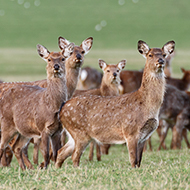
New research from Trinity College Dublin suggests that increasing populations of sika deer in Ireland may be linked to local outbreaks of TB infection in cattle.

The research – published in Frontiers in Veterinary Science – found that, despite a decrease in TB infection rates in recent decades, there is a correlation between rising sika populations and higher local TB infections.

Dr David Kelly, first author of the journal article, said: “Irish farmers have been aware of the effects of bovine TB for well over 70 years. Its incidence has steadily diminished in Ireland, from 3 per cent in 1960 to 0.3 per cent some 50 years later.

“In the mid-1980s it became clear European badgers were a TB wildlife host. Since then, badger populations have been controlled around farms with TB outbreaks whenever those outbreaks cannot be linked to cattle.

“In recent years, however, it has become clear that controlling TB in badger populations cannot rely on culling alone. Along with this change in thinking, there has been a steady shift away from culling and towards badger vaccination.

“Unfortunately, while the management of one TB wildlife host has made great advances, another wildlife TB host has appeared on the radar: deer.”

Studies in Europe and the USA have shown that deer, at higher densities, can sustain TB in their herds. This new research has aligned with these findings, identifying certain populations of sika deer as maintenance hosts of TB in Ireland.

Dr Kelly concluded: “Now, when attempting to manage TB in wildlife, sika deer will need to be considered as well as badgers. Our analyses suggest Sika deer are currently of greatest concern in County Wicklow but if numbers continue to rise in other counties they may also pose problems elsewhere.”


Become a member or log in to add this story to your CPD history

RCVS announces 1CPD app update

News Story 1
 The RCVS has announced a new version of its 1CPD mobile app, with enhanced features for veterinary surgeons and veterinary nurses to record their continuing professional development.

The mobile app includes a new 'what would you like to do?' shortcut for frequent tasks, a notification badge, and the ability to scan a QR code from the home screen to easily record an activity.

Users will be prompted to update the app from the App Store or Google Play the next time they log in. For more information, visit RCVS.org.uk 

Click here for more...
News Shorts
Nominations open for RCVS and VN Council elections

The nomination period for the 2026 RCVS Council and VN Council elections is now open, with three veterinary surgeon seats and two veterinary nurse seats available.

Prospective candidates can download an information pack and nomination form from the RCVS website. Individuals can nominate themselves for the elections, with the results to be announced in the spring.

Clare Paget, the recently appointed RCVS Registrar and elections returning officer, said: "If you want to play your part in influencing and moulding how the professions are regulated, and making key decisions on matters of great importance to your peers, the public and animal health and welfare, please consider standing for RCVS Council or VN Council next year."

Nominations close at 5pm on Saturday, 31 January 2026.

