


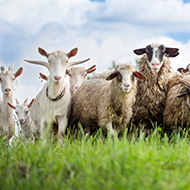
Study suggests that goats 'are more cognitively flexible than sheep'.
A new study by researchers at Martin Luther University Halle-Wittenberg (MLU) and the Leibniz Institute for Farm Animal Biology (FBN) investigated how sheep and goats 'problem-solve' to navigate around obstacles to reach food.
Dr Christian Nawroth from FBN explains: “It is important that animals are able to react swiftly to a changing environment because this allows them to find and exploit new food sources.”
An experiment was set up with 21 goats and 28 sheep at the Agroscope research centre in Switzerland, Queen Mary University London (QMUL) and the Buttercups Sanctuary for Goats in Kent.
The experiment saw one animal at a time led to one end of a small enclosure, with a researcher stood at the opposite end offering food and a fence with a gap in-between the two.
The researchers examined the animals' behaviour and recorded the time it took them to reach the food. After a few attempts, they changed the position of the gap in the fence and repeated the test.
In the first round, goats managed to walk around the obstacle quickly and more easily, although sheep were faster on average. Both types of animals needed a few attempts to adjust to the new position of the gap in the second round, but made fewer mistakes after this.
“Goats appear to adapt better and more accurately to new situations and move with less perseveration around the obstacle when the gap has changed.” Said co-author Dr Britta Osthaus from Canterbury Christ Church University.
“This suggests that they are more cognitively flexible than sheep.” The researcher added that the reason for these differences could be differing foraging strategies, as sheep are foragers while goats are 'browsers', preferring buds and fresh shoots.


 Defra has published guidance for the vet sector ahead of a proposed UK-EU Sanitary and Phytosanitary agreement.



