


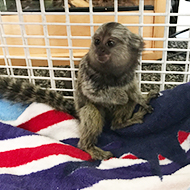
TikTok the marmoset was found living in terrible conditions in Essex.
The RSPCA has rescued an infant marmoset who was discovered to be living in bad conditions in a private home in Grays, Essex.
TikTok, named after the social media platform, was living alone in a small bird cage with no enrichment or companionship.
Despite the fact that the Government is taking action on trading and keeping primates in its Animal Welfare (Kept Animals) Bill, the RSPCA believes that this is not enough, and is urging the Government to reconsider its proposals.
The charity considers a ban on the keeping and trading of pet primates to be the only acceptable answer to protect primate welfare.
Jack Taylor, RSPCA inspector commented on the keeping of primates as pets: “TikTok's case perfectly highlights why primates should not be available to the public and why they do not belong in people's homes.
“Just like humans, primates can become depressed without adequate stimulation. They need a spacious and enriched environment that challenges their intelligent brains and allows for them to behave like primates should.
“But, sadly, Inspectors like me are still seeing shocking situations where monkeys are cooped up in bird cages, fed fast food, sugary drinks or even Class A drugs, deprived of companions of their own kind, living in dirt and squalor and suffering from disease.”
TikTok's situation was made even worse by the fact that he is an infant marmoset, and only a few months old. At his age, he should still be receiving care and nursing from his mother.
Inspector Jack added: “He needed rescuing urgently and luckily, after obtaining an agreement for him to be signed over into our care, we were able to find him a forever home at Monkey World.
“Monkey World Director, Dr Alison Cronin, drove up the same day to bring the youngster back to the centre to meet his new family. We would like to thank this wonderful rescue centre for providing him with a safe and appropriate home for life where all his needs can be met.”
The baby marmoset is now living with an adult pair of marmosets, who instantly adopted him, and are now caring for him, reflecting the necessity of parental care for baby marmosets.
Image (C) RSPCA


 Defra has published guidance for the vet sector ahead of a proposed UK-EU Sanitary and Phytosanitary agreement.



