
Your data on MRCVSonline
The nature of the services provided by Vision Media means that we might obtain certain information about you.
Please read our Data Protection and Privacy Policy for details.

In addition, (with your consent) some parts of our website may store a 'cookie' in your browser for the purposes of
functionality or performance monitoring.
Click here to manage your settings.
If you would like to forward this story on to a friend, simply fill in the form below and click send.

Your friend's email:
Your email:
Your name:
 
 
Send Cancel

New first aid course for pet owners
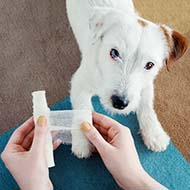
The course includes detailed veterinary advice to help owners deal calmly with emergency scenarios.
Busy Bees Education and Training has teamed up with Blue Cross to deliver vital education.

A first aid course for pet owners has been launched by Busy Bees Education and Training to help people learn how to keep their animals healthy and take positive action in an emergency.

The online course, developed in conjunction with Blue Cross veterinary experts, includes interactive games, video interviews and quizzes to help pet owners recount vital information in critical situations.

Its launch follows the publication of the 2021 PDSA Animal Wellbeing (PAW) Report, which sparked calls for new pet owners to seek support when it comes to looking after their animals. The report found that almost half of all pet owners who acquired their animals since the start of the COVID-19 pandemic were first-time pet owners. 

The course, designed for pet owners old and new, is split into three main sections:
 
  • Preventative health - a comprehensive guide to vaccinations, diet, and grooming. 
  • Hazards in the home, garden and on a walk – puppy Max and his human family explore potential everyday dangers in the household and outside world.
  • What to do in a pet emergency – detailed veterinary advice to help owners deal calmly with a wide range of life-threatening scenarios.
“Being a pet owner is a huge responsibility," commented Kim Lakin-Smith, course content writer from Busy Bees Education and Training. "Unlike humans, if our pet has a medical emergency that needs immediate attention, there’s no emergency services or ambulance to call on. 

"The responsibility to administer first aid in a calm, timely and effective manner lands on us. Preparing ourselves to respond to an emergency or, even better preventing one, is the best way we can help our beloved animal friends to enjoy long, healthy, and happy lives.”

The course takes one hour to complete and costs £17.50. For more information, visit busybeestraining.co.uk


Become a member or log in to add this story to your CPD history

Equine Disease Surveillance report released for Q4 2025

News Story 1
 The latest Equine Disease Surveillance report has been released, with details on equine disease from Q4 of 2025.

The report, produced by Equine Infectious Disease Surveillance, includes advice on rule changes for equine influenza vaccination.

Statistics and maps detail recent outbreaks of equine herpes virus, equine influenza, equine strangles and equine grass sickness. A series of laboratory reports provides data on virology, bacteriology, parasitology and toxicosis.

This issue also features a case study of orthoflavivus-associated neurological disease in a horse in the UK. 

Click here for more...
News Shorts
NSA webinar explores sheep tailing and castration

The National Sheep Association (NSA) is to host a free webinar on the castration and tail docking of lambs.

The webinar, 'Understanding the tailing and castration consultation: A guide for sheep farmers', will be hosted online on Monday, 2 March 2026 at 7.30pm.

It comes during a government consultation into the methods used for these procedures. Farmers are encouraged to engage before the consultation period closes on Monday, 9 March 2026.

The webinar offers clear and actionable guidance to support farmers to contribute meaningfully to the consultation and prepare for potential changes.

On the panel will be former SVS president Kate Hovers, farmer and vet Ann Van Eetvelt and SRUC professor in Animal Health and Veterinary Sciences Cathy Dwyer. Each panel member will utilise their own specialism and expertise to evaluate risks and outcomes to sheep farming.

Find out more about the webinar on the NSA website.

