


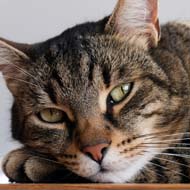
Stanford researchers have discovered some of the genetics behind cat colouring.
Scientists at the University of Stanford have discovered a key gene that contributes to the development of stripes, blotches, spots and patterns on a cats fur.
The study, led by Stanford Medicine researchers, identified the gene DKK4, which helps to regulate the early development of different fur patterns in domestic cats.
It is thought that DKK4 may likely also be involved in colour patterns in all types of cat, and possibly in other mammals.
In a report on Stanford University's news page, Gregory Barsh, lead author of the study, commented: “Color patterns are one of these unsolved biological mysteries; there’s no go-to model organism to study it — mice don’t have stripes or spots.
“The color patterns and variability that you see in animals like tigers, cheetahs and zebras prompted some central questions for us: What are the developmental genetic mechanisms and the cellular mechanisms that give rise to these patterns and how have they been altered during mammalian evolution to give rise to the amazing diversity of shape and form we see today?”
When studying fetal cat tissue, researchers found a thickening of the skin tissue in certain areas, which seemed to foreshadow fur colour. The thickened skin tissue marked out the areas where the fur will later be darker, whilst the thin area marked out where patches of fur would be lighter.
This 'prepattern' provided an entry point for the researcher's discovery of how DKK4 effects fur pattern - when they inspected the genetic makeup of individuals cells in the thinner and thicker areas, they found that DKK4 was particularly active in the thickened skin.
Moving their research to Abyssinian cats, the researchers identified disrupting mutations in the DKK4 gene, which were responsible for the breed's lack of tabby markings.
Speaking on this discovery in the Stanford report, Barsh said: “If you remove DKK4, the dark areas don’t go away entirely, but they become smaller and more packed together.”
The researchers do not yet know how it is that DKK4 affects colour patterns in domestic cats' fur. However, they have found that DKK4 interacts with WNTs, a class of proteins which are significant in early development.
WNTs and DKK4 form a 'prepattern' when the feline embryos are two or three millimetres in length – a significant amount of time before pigment is produced in hairs.
Barsh told Stanford News: “This is one of the big unanswered questions in our work — how to connect the process of prepattern formation to the process that implements the pattern later in development.
“That’s something that we’re actively trying to figure out.
“There are still other genes that are behind why, for instance, some cats have spots and why some cats have stripes.”
Initially published in Nature Communications, the findings are available to read here.


 BVA has announced a new series of its Building Great Workplaces lunchtime webinars.



