
Your data on MRCVSonline
The nature of the services provided by Vision Media means that we might obtain certain information about you.
Please read our Data Protection and Privacy Policy for details.

In addition, (with your consent) some parts of our website may store a 'cookie' in your browser for the purposes of
functionality or performance monitoring.
Click here to manage your settings.
If you would like to forward this story on to a friend, simply fill in the form below and click send.

Your friend's email:
Your email:
Your name:
 
 
Send Cancel

Study highlights risks of early hydrotherapy following spinal surgery
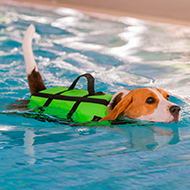
The study recorded major complications in 26 dogs that had commenced hydrotherapy within five days of IVDE surgery.
Major complications include euthanasia, acute dermatitis and spinal abscess.

Early hydrotherapy may be linked to an increased risk of postoperative complications following intervertebral disc extrusion (IVDE) surgery, according to new research.
 
In the study, published in the Journal of Small Animal Practice (JSAP), scientists reviewed the medical records of 83 dogs that had been treated with hemilaminectomy for acute or chronic thoracolumbar IVDE and had commenced hydrotherapy within five days of surgery. 

Postoperative complications were considered major if there was a need for hospitalisation, surgery or if the dog died or was euthanised as a direct consequence of the complication. A complication was deemed minor if outpatient medical treatment was sufficient to rectify it. 

Study co-author Dr Abtin Morjarradi said: “A total of 10 minor complications were recorded during the study period, including surgical site infection, diarrhoea and urinary tract infection. Major complications were recorded in 26 dogs during the study period and included euthanasia, acute dermatitis, spinal abscess and disc extrusion. 

“Reasons for euthanasia were urinary incontinence, lack of neurological improvement, clinical suspicion of progressive myelomalacia, persistent pain, aggression and widespread cellulitis with an abscess caudal to the right stifle without known cause.”

JSAP editor Nicola Di Girolamo said: “Whilst previous studies indicate that early rehabilitation may be beneficial after acute spinal cord injury, the optimal timing to start hydrotherapy is unclear. 

“Despite a high number of complications being recorded in the present study, it is not clear how many of these complications were directly related to the initiation time of hydrotherapy and therefore further research is required.”


Become a member or log in to add this story to your CPD history

Equine Disease Surveillance report released for Q4 2025

News Story 1
 The latest Equine Disease Surveillance report has been released, with details on equine disease from Q4 of 2025.

The report, produced by Equine Infectious Disease Surveillance, includes advice on rule changes for equine influenza vaccination.

Statistics and maps detail recent outbreaks of equine herpes virus, equine influenza, equine strangles and equine grass sickness. A series of laboratory reports provides data on virology, bacteriology, parasitology and toxicosis.

This issue also features a case study of orthoflavivus-associated neurological disease in a horse in the UK. 

Click here for more...
News Shorts
NSA webinar explores sheep tailing and castration

The National Sheep Association (NSA) is to host a free webinar on the castration and tail docking of lambs.

The webinar, 'Understanding the tailing and castration consultation: A guide for sheep farmers', will be hosted online on Monday, 2 March 2026 at 7.30pm.

It comes during a government consultation into the methods used for these procedures. Farmers are encouraged to engage before the consultation period closes on Monday, 9 March 2026.

The webinar offers clear and actionable guidance to support farmers to contribute meaningfully to the consultation and prepare for potential changes.

On the panel will be former SVS president Kate Hovers, farmer and vet Ann Van Eetvelt and SRUC professor in Animal Health and Veterinary Sciences Cathy Dwyer. Each panel member will utilise their own specialism and expertise to evaluate risks and outcomes to sheep farming.

Find out more about the webinar on the NSA website.

