


Vets complete arctic trek to help rhinos
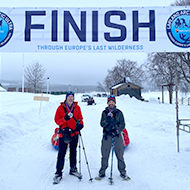
John and David raised money for the organisation, Helping Rhinos.
Two veterinary surgeons have successfully completed the Montane Lapland Arctic Ultra, raising money to save the rhino from extinction.
David Abratt and John Beel raised more than £3,200 travelling through rivers, lakes and forests and crossing the arctic circle twice over the duration of the course.
Trekking 185km of snow and ice in Swedish Lapland from 6 – 16 March, the veterinary surgeons managed to complete the gruelling course.
David Abratt commented on their experience: “When we first arrived, we undertook a compulsory cold weather survival course. Without it, we’d have struggled, and likely become icicles once out on the course!
“We had some lovely crisp sunny days of -5 degrees but, on others, and at night, temperatures could drop to -20 with windchill. The snow was something else! Literally hip to chest deep in some places and, if you stepped in the wrong place, it was difficult to get out.
“Physically the event was tough and relentless. We completed each day usually between midnight and 1am, then had to set up camp - a mission in itself in the freezing conditions. Then we were up at 5.30 am to do it all again!”
John Beel said: “As an unsupported race, the only contact we had with officials was for the mandatory medical checks. Primarily, they were to check for frost bite injury but, more importantly, they were a source of hot chocolate - a small blessing!
“We had the usual long distance or endurance niggles, like muscle and joint pain, but a new one on us was ‘crackies’, a cold weather injury in which cracks develop in the skin of the extremities, like finger tips. It is incredibly painful.
“Despite this, we managed to complete the course and, while we weren’t anywhere near the front of the pack, the feeling of accomplishment on completing the race put a smile on our faces that was difficult to wipe off!”
Donations can still be made to John and David's fundraising page here.


 Defra has published guidance for the vet sector ahead of a proposed UK-EU Sanitary and Phytosanitary agreement.



