
Your data on MRCVSonline
The nature of the services provided by Vision Media means that we might obtain certain information about you.
Please read our Data Protection and Privacy Policy for details.

In addition, (with your consent) some parts of our website may store a 'cookie' in your browser for the purposes of
functionality or performance monitoring.
Click here to manage your settings.
If you would like to forward this story on to a friend, simply fill in the form below and click send.

Your friend's email:
Your email:
Your name:
 
 
Send Cancel

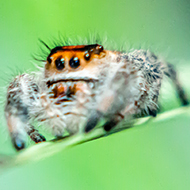
Regal jumping spiders arrive at ZSL London Zoo
Regal jumping spiders can jump 10cm forwards from a standing start, spinning a line of silk behind them to ensure a safe landing.

The spiders will be helping people to cure arachnophobia. 

ZSL London Zoo has welcomed regal jumping spiders to its Tiny Giants exhibit, and these distinctive creatures will be helping arachnophobes overcome their fear in the zoo's Friendly Spider Programme.

Dave Clarke, London Zoo's head of invertebrates, said: “At just 22mm regal jumping spiders may be small, but are very cute as they have recognisable ‘face’ with forward pointing eyes and some of the best vision in the spider world.”

These spiders, hailing from the southeastern United States and the West Indies, can jump 10cm forward from a standing start by suddenly flexing the muscles in their legs. They are also known for their courtship dance, which the male regal jumping spiders do to attract a mate. 

The spiders have arrived in time for participants of the zoo's Friendly Spider Programme to meet them, in their quest to overcome a fear of spiders. The programme, which runs periodically, teaches participants all about spiders, squashes myths, and gives them a chance to practice catching spiders.

“We’ve made it our mission to quash as many myths about spiders as possible and help people overcome their phobia, converting spider-squishers into bug lovers through our world-leading Friendly Spider Programme – and I think these cute new arrivals are going to be a big help,” said Dave Clarke. 

“As well as helping to alleviate a phobia that can seriously impact your day-to-day life, the Friendly Spider Programme has directly supported wildlife conservation projects for invertebrates, including the successful reintroduction of the native semi-aquatic Fen raft spider. 

“This species is listed as threatened in the UK, but the fen raft spider’s range is now increasing thanks to conservation efforts.”


Images (C) ZSL London Zoo

Become a member or log in to add this story to your CPD history

Equine Disease Surveillance report released for Q4 2025

News Story 1
 The latest Equine Disease Surveillance report has been released, with details on equine disease from Q4 of 2025.

The report, produced by Equine Infectious Disease Surveillance, includes advice on rule changes for equine influenza vaccination.

Statistics and maps detail recent outbreaks of equine herpes virus, equine influenza, equine strangles and equine grass sickness. A series of laboratory reports provides data on virology, bacteriology, parasitology and toxicosis.

This issue also features a case study of orthoflavivus-associated neurological disease in a horse in the UK. 

Click here for more...
News Shorts
NSA webinar explores sheep tailing and castration

The National Sheep Association (NSA) is to host a free webinar on the castration and tail docking of lambs.

The webinar, 'Understanding the tailing and castration consultation: A guide for sheep farmers', will be hosted online on Monday, 2 March 2026 at 7.30pm.

It comes during a government consultation into the methods used for these procedures. Farmers are encouraged to engage before the consultation period closes on Monday, 9 March 2026.

The webinar offers clear and actionable guidance to support farmers to contribute meaningfully to the consultation and prepare for potential changes.

On the panel will be former SVS president Kate Hovers, farmer and vet Ann Van Eetvelt and SRUC professor in Animal Health and Veterinary Sciences Cathy Dwyer. Each panel member will utilise their own specialism and expertise to evaluate risks and outcomes to sheep farming.

Find out more about the webinar on the NSA website.


