
Your data on MRCVSonline
The nature of the services provided by Vision Media means that we might obtain certain information about you.
Please read our Data Protection and Privacy Policy for details.

In addition, (with your consent) some parts of our website may store a 'cookie' in your browser for the purposes of
functionality or performance monitoring.
Click here to manage your settings.
If you would like to forward this story on to a friend, simply fill in the form below and click send.

Your friend's email:
Your email:
Your name:
 
 
Send Cancel

Trio of critically endangered tiger cubs born
Keepers are keeping watchful eye on the new trio via a special 'cubcam'.

ZSL London Zoo announces arrival of rare Sumatran tigers.

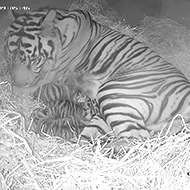
Hidden cameras at ZSL London Zoo captured the exciting moment three Sumatran tiger cubs arrived, born on Monday 27 June.

In the early hours of the morning, keepers watched the live footage with bated breath as mum Gaysha gave birth to the cubs in her purpose-built cubbing den. 

The births are a boost to the Sumatran tiger population, with the species classified as Critically Endangered. The smallest tiger subspecies, only an estimated 300 remain in the wild, with habitat loss, poaching and human-wildlife conflict contributing to the subspecies decline. 

Mum Gaysha and dad Asim live in the zoo's Tiger Territory enclosure, which, with the help of the zoo's other Sumatran tigers, has welcomed eight new cubs.

Kathryn Sanders, tiger keeper at ZSL London Zoo, discussed the preparation needed to welcome the new additions: “We were confident that Gaysha was pregnant and had estimated roughly how far along she was - when we observed her stomach grow noticeably in the past few weeks, we knew she was nearing full-term.

“We prepared her a special indoor cubbing den, filled it with soft straw for comfort, and began a nightly vigil - monitoring her progress remotely on screen.”

All three cubs are reportedly doing well, and have already begun to feed and take their first wobbly steps. After their first set of vaccinations at three months old the cubs will be named, but until then, the special trio will growing and learning with minimal disturbance from keepers.

Kathryn added: “While we’re keeping a close eye via cubcam, we’re also taking care not to disturb the family so that they can continue to bond together - we can’t wait to get to know the little ones as they grow bigger and begin to explore their surroundings.”


Image (C) Zoological Society of London

Become a member or log in to add this story to your CPD history

Equine Disease Surveillance report released for Q4 2025

News Story 1
 The latest Equine Disease Surveillance report has been released, with details on equine disease from Q4 of 2025.

The report, produced by Equine Infectious Disease Surveillance, includes advice on rule changes for equine influenza vaccination.

Statistics and maps detail recent outbreaks of equine herpes virus, equine influenza, equine strangles and equine grass sickness. A series of laboratory reports provides data on virology, bacteriology, parasitology and toxicosis.

This issue also features a case study of orthoflavivus-associated neurological disease in a horse in the UK. 

Click here for more...
News Shorts
NSA webinar explores sheep tailing and castration

The National Sheep Association (NSA) is to host a free webinar on the castration and tail docking of lambs.

The webinar, 'Understanding the tailing and castration consultation: A guide for sheep farmers', will be hosted online on Monday, 2 March 2026 at 7.30pm.

It comes during a government consultation into the methods used for these procedures. Farmers are encouraged to engage before the consultation period closes on Monday, 9 March 2026.

The webinar offers clear and actionable guidance to support farmers to contribute meaningfully to the consultation and prepare for potential changes.

On the panel will be former SVS president Kate Hovers, farmer and vet Ann Van Eetvelt and SRUC professor in Animal Health and Veterinary Sciences Cathy Dwyer. Each panel member will utilise their own specialism and expertise to evaluate risks and outcomes to sheep farming.

Find out more about the webinar on the NSA website.


