


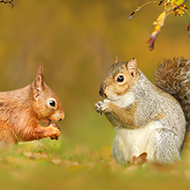
The scheme could eradicate grey squirrels in the UK and save their red cousins from extinction.
Government researchers are planning to use oral contraceptives as a more humane way to control grey squirrel populations and help the falliing numbers of reds.
The project, led by scientists at the Animal Health and Plant Agency (APHA), involves lacing pots of hazelnut paste with the contraceptives and placing them inside squirrel feeding boxes.
According to BBC News, the contraceptives make both male and female squirrels infertile and could be ready within the next two years.
Originally introduced from North America, grey squirrels are common across the UK but cause widespread damage to woodland ecosystems. The squirrels harm trees by stripping away at the bark to get to the sweet sap underneath.
Grey squirrels are also a threat to their native red cousins as they outcompete them for food and habitat. They are much stronger than red squirrels, and carry the squirrel pox virus, to which they are immune, but it is usually fatal to reds.
Study lead Dr Giovanna Massei from the APHA said dosing the squirrels with contraceptives will be more humane and ultimately more effective than the traditional method of culling.
She said that her team had produced a vaccination that causes the immune system to limit the production of sex hormones, rendering squirrels incapable of reproducing. Further research is underway to determine a dosage that has a long-lasting impact and is secure for usage in the wild because the medication is not permanent.
To prevent other species accessing the medication, Massei's team has also designed a special feeding hopper. The hopper has a weighted door that allows access to 70 per cent of squirrels and prevents access to most other wildlife species.
Scientists are also trialling feeders in areas where there are red and grey squirrels, with a special weighted plate that will only allow access to the heavier grey squirrel.
Computer modelling by the scientists has revealed that the contraceptive plan could bring grey squirrel populations to the brink of extinction in certain places.
"It could even eradicate them from some areas, provided you can do a coordinated control over an area, so they don't start to re-immigrate", said Dr Massei.
She added that if the work with grey squirrels proves effective, it could also be used to control other wildlife populations, such as deer, rats and mice.
The UK Squirrel Accord (UKSA), a collaboration of forestry and conservation organisations, is funding the research.


 Defra has published guidance for the vet sector ahead of a proposed UK-EU Sanitary and Phytosanitary agreement.



