


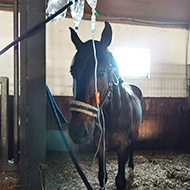
Charitable foundation issues plea for diagnostic equipment.
More than 20,000 horses remain in the 'critical welfare zone' in Ukraine, and the situation is 'getting worse over time', an equestrian charity has warned.
Stress due to the war environment, restricted food intake, wounds and relocation are among the most common challenges faced by equine vets in the country, five months after Russia's invasion began.
A survey of almost all practising Ukrainian equine veterinary surgeons conducted by the Ukraine Equestrian Federation Charity Foundation (UEF-CF) also revealed that lack of medicines and medical equipment are significant issues.
The survey found that while essential medicine for horses is readily available, thanks to the help of international veterinary organisations, it is quickly spent owing to the poor condition of the horses. Furthermore, because horse owners are losing their jobs and income, they cannot pay for treatment, and this is directly affecting horse welfare.
Secondly, the survey revealed a lack of professional diagnostic equipment in the country, including portable x-rays, ultrasound and endoscope machines. The same devices often need to be transferred great distances across Ukraine, impacting vets' ability to make a timely diagnosis due to the weakening condition of the horses.
UEF-CF founder Mykhaylo Parkhomchuk, who is also secretary-general of the Ukrainian Equestrian Federation, said: “Despite the summer period and humanitarian help with horse food, the risks still remain, as the war does not stop. The need for relocation horses continue.
"This leads to a decrease in immunity and diseases that end in complications and deaths. In these critical moments, the lack of medicines and medical equipment for veterinarians is the main challenge for saving the horse's life.”
There are currently just 30 equine vets available for the increased needs of horses in the whole of Ukraine - a territory equivalent in size to France. The survey found that many vets do not request payment for their services because horse owners cannot afford it.
Taisia Stadnichenko, head of Ukrainian Operations for the UEF-CF, said that vets often ask owners to pay them only to cover fuel expenses due to the fuel shortage in the country.
“It is probably worth thinking about a separate fund to pay for the services of veterinarians who care for horses for free or at a minimal cost," she said. "They do a great job over a large area and in particularly difficult and often dangerous conditions.”
In light of its findings, the UEF-CF is calling for veterinary partnerships to source and deliver portable diagnostics equipment to increase the availability of facilities in at least three Ukrainian regions.
“A UEF-CF spokesperson said: “Thanks to the generous support of international organisations and private persons, the urgently needed basic veterinary supplies are shipped regularly. But due to the weakening health of horses, these basic supplies are not enough for more serious cases. There are also plans for online workshops and training sessions as well as short-term veterinary missions to Ukraine.
“The war in Ukraine is not over yet. It has been going on for 146 days already and the humanitarian crisis deteriorates at alarming speed. The problem is getting worse by the fact that horse owners are losing their jobs and can’t pay for medicine and veterinary services. Ukrainian veterinary professionals are very concerned about the horses´ welfare and accessibility of professional veterinary help.”
For more information, to make a donation or to offer help, visit helpukrainehorses.eu
Image (C) UEF-CF.


 Defra has published guidance for the vet sector ahead of a proposed UK-EU Sanitary and Phytosanitary agreement.



