


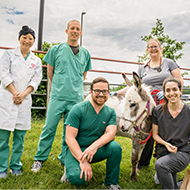
Nix had been diagnosed with a third-degree atrioventricular block.
A miniature donkey with a severe heart condition has been successfully fitted with a pacemaker.
Three-month-old Nix began showing signs of weakness and collapse in the autumn of 2020. When it became clear that her condition was not improving, her vet referred her to Cornell University College of Veterinary Medicine, where she was diagnosed with a third-degree atrioventricular block.
Nix's condition meant that her atria and ventricles were not communicating, making the rhythm of her heart dangerously slow and irregular. She was exhibiting the classic signs of the illness, such as collapse, spells of weakness and extreme exercise intolerance, caused by her brain and body not receiving enough blood for long periods.
Dr Katharyn Mitchell, who oversaw Nix’s case at Cornell, said: “This is a pathological arrhythmia that we see pretty uncommonly in horses, but a little more occasionally in donkeys, and especially mini donkeys. Given the severity of the arrhythmia and the frequency of collapse, medication will not be effective, so we only had the choice of placing a pacemaker or euthanasia, given the high risk of continued self-trauma.”
Given her age, Nix's owners and care team agreed that a pacemaker would vastly improve her odds for a healthy future. The surgery is the first of its kind on a large animal species at Cornell and was a huge success.
Nix is said to have bounced back quickly from the procedure, and the team noticed an immediate improvement. Now she has enough blood flow to her brain to let her walk normally, without any fainting episodes or lethargy.
The pacemaker battery will need replacing after around seven to nine years, but if the device continues to work well, Nix will live an ordinary life. In the near term, she will need to remain calm and exercise sparingly to avoid pulling the pacemaker lead out of her cardiac muscle.
Dr Mitchell added: “We will keep her calm for the first month to lower these risks, and if everything looks okay, then we will increase the pacemaker’s rate a little bit so she can get up some speed and play with her mum in the paddock.”
Image (C) Cornell University College of Veterinary Medicine/Darcy Rose.


 Defra has published guidance for the vet sector ahead of a proposed UK-EU Sanitary and Phytosanitary agreement.



