
Your data on MRCVSonline
The nature of the services provided by Vision Media means that we might obtain certain information about you.
Please read our Data Protection and Privacy Policy for details.

In addition, (with your consent) some parts of our website may store a 'cookie' in your browser for the purposes of
functionality or performance monitoring.
Click here to manage your settings.
If you would like to forward this story on to a friend, simply fill in the form below and click send.

Your friend's email:
Your email:
Your name:
 
 
Send Cancel

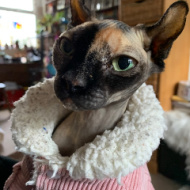
Sphynx cat undergoes complex corneal graft
"Felicity's right eye had a corneal sequestrum with evidence of 'corneal melting' at its periphery" - Adam Margetts.

Corneoconjunctival transposition performed by ophthalmology specialists. 

A sphynx cat named Felicity has had her sight saved following a complex surgery at Davies Veterinary Specialists in Hertfordshire.

The four-year-old cat was brought into her local veterinary surgery when her owners noticed her squinting her right eye. 

Felicity's veterinary surgeon was concerned about the appearance of her eye, and referred her to the ophthalmology department at Davies.

Davies ophthalmology team diagnosed Felicity with a deep corneal sequestrum, an area of dead cornea, which needed surgery to save her vision.

Adam Margetts, ophthalmology resident, explained: “Felicity’s right eye had a corneal sequestrum with evidence of "corneal melting" at its periphery which required surgical intervention in order to prevent further deterioration.”

The ophthalmology team placed Felicity under general anaesthetic, and then removed the sequestrum and diseased cornea. 

Following this, a graft using her healthy cornea was used to stabilise the deep corneal defect, and hair-thin dissolvable sutures attached the graft to the cornea.

The complex corneal graft was a success, and Felicity was discharged the day after her surgery. 

Adam continued: “We are delighted that Felicity has regained full and pain-free use of her right eye.

“Her owner is aware that the formation of new ulcers and corneal sequestra remain possible in the future, but with regular check-ups we can stay a step ahead and treat early if required.”


Image (C) Davies Veterinary Specialists

Become a member or log in to add this story to your CPD history

Submissions open for BSAVA Clinical Research Abstracts 2026

News Story 1
 The BSAVA has opened submissions for the BSAVA Clinical Research Abstracts 2026.

It is an opportunity for applicants to present new research on any veterinary subject, such as the preliminary results of a study, discussion of a new technique or a description of an interesting case.

They must be based on high-quality clinical research conducted in industry, practice or academia, and summarised in 250 words.

Applications are welcome from vets, vet nurses, practice managers, and students.

Submissions are open until 6 March 2026. 

Click here for more...
News Shorts
Survey seeks ruminant sector views on antimicrobial stewardship

A new survey is seeking views of people working in the UK ruminant sector on how to tackle the challenge of demonstrating responsible antibiotic stewardship.

Forming part of a wider, collaborative initiative, the results will help identify the types of data available so that challenges with data collection can be better understood and addressed.

Anyone working in the UK farming sector, including vets and farmers,is encouraged to complete the survey, which is available at app.onlinesurveys.jisc.ac.uk


