


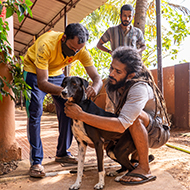
The veterinary charity has immunised two million dogs since 2013.
Veterinary charity Mission Rabies is celebrating after vaccinating two million dogs across the globe against rabies.
Announced on World Rabies Day (28 September), the milestone is the result of the charity’s mass vaccination campaigns that have been running since 2013 to stop human deaths from the disease by 2030.
Rabies is a vaccine-preventable viral disease that kills at least one child every nine minutes. It has one of the highest fatality rates of any infectious disease, and death is inevitable once clinical symptoms appear.
Dog bites are a significant source of rabies and are responsible for 99 per cent of all human cases. As such, dog vaccination is the most effective long-term strategy against the disease.
Mission Rabies runs mass canine vaccination campaigns, surveillance, and community education programmes in the world’s worst rabies affected areas, including Malawi, India, Sri Lanka, Zambia, Uganda, Tanzania, Ghana, Mozambique, Cambodia, and Thailand.
The charity was founded by veterinary surgeon Dr Luke Gamble after he saw the devastating effect of rabies whilst working in India.
Dr Gamble said: “I started Mission Rabies after seeing first-hand the devastating impact that this disease has on so many children in developing countries. There was already research showing that vaccinating dogs not only stops ineffective mass canine cull campaigns but also prevents human rabies deaths – the challenge was powering on to find a way to get 70 per cent of dogs vaccinated in the worst affected rabies endemic areas.
“Thanks to the incredible efforts of so many amazing team members, sponsors, volunteers and supporters, we’ve now vaccinated over two million dogs and eliminated rabies from some key project sites – including an entire Indian state. I’m hugely proud to be a part of the Mission Rabies team, and we’re all delighted with this landmark achievement.”
Mission Rabies uses a bespoke ‘Rabies app’, developed with its sister charity Worldwide Veterinary Service, to deliver canine vaccinations on a mass scale. The app contains data about each vaccinated dog to help with rabies and dog population research, and to ensure campaigns are effective and measurable.
Andy Gibson, director of strategic research at Mission Rabies, said: “Our smartphone app has been fundamental in reaching this milestone. Each project must ensure 70 per cent of dogs are vaccinated to establish herd immunity in the local canine population, breaking transmission and saving lives.
“The app helps us measure this in a scientific manner, indicating areas where further vaccination work is required and directing teams on the ground to respond to rabies outbreaks. This technology has been a game changer for our work. It was pivotal in supporting Goa to recently become a rabies-controlled state, the first of its kind in India.”
Image (C) Mission Rabies.


 BVA has announced a new series of its Building Great Workplaces lunchtime webinars.



