


New X-ray technique could transform poultry breeding
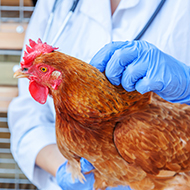
“Our method represents a major development to aid selection towards improving bone strength, and health and welfare, in laying hens” -Prof Ian Dunn, The Roslin Institute.
Farmers may soon be able to choose the best birds with which to breed – and therefore enhance animal welfare - by using a quick, safe approach for analysing bone density in live hens.
Researchers at The Roslin Institute have created a digital X-ray procedure that takes around 45 seconds to complete, is practical for hens and poultry workers, and yields reliable, reproducible results.
Through the method, described in British Poultry Science, poultry breeders may soon be able to consider bone density when selecting laying hens, which are at risk of fractures from biological changes linked with laying eggs.
Professor Ian Dunn, personal chair of avian biology at The Roslin Institute, said: “For many decades, poultry breeders have chosen which birds to breed according to a mix of many factors, but it has not been possible to account for bone quality in live hens, and a practical method of measuring bone quality in hens has been unavailable. Our method represents a major development to aid selection towards improving bone strength, and health and welfare, in laying hens.”
Recent developments in digital X-ray technology have allowed scientists to refine their methods for taking and analysing pictures related to bone density.
The new method involves quickly capturing digital X-rays of live hens, from which their leg bone density can be calculated, and data digitally shared. The procedure lasts around 45 seconds, offering a more practical, faster alternative to conventional imaging methods.
Birds with the freedom to roam about their environment benefit from strong bones since their health is better, and they have a decreased risk of fractures. The keel bone, or sternum, of chickens, is particularly prone to injury, and prior work by the same team has shown that fracture risk and keel bone density are genetically related.
The team adds that the method could help mitigate the number of animals required for research into nutritional and management aids for bone health.


 Defra has published guidance for the vet sector ahead of a proposed UK-EU Sanitary and Phytosanitary agreement.



