
Your data on MRCVSonline
The nature of the services provided by Vision Media means that we might obtain certain information about you.
Please read our Data Protection and Privacy Policy for details.

In addition, (with your consent) some parts of our website may store a 'cookie' in your browser for the purposes of
functionality or performance monitoring.
Click here to manage your settings.
If you would like to forward this story on to a friend, simply fill in the form below and click send.

Your friend's email:
Your email:
Your name:
 
 
Send Cancel

Views sought on plans to ease OV shortage
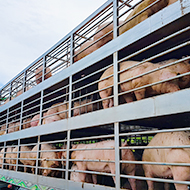
Official veterinarians have an essential role to play in maintaining the delivery of official controls.
The FSA is engaging with abattoirs on proposed changes to the delivery of official controls.

As the UK veterinary workforce crisis deepens, the Food Standards Agency (FSA) has written to abattoir workers inviting feedback on proposed changes to how FSA delivers controls through Official Veterinarians (OVs).

Figures released by the RCVS show that between 2019 and 2021, joiners to the UK veterinary profession fell by 26 per cent, while 2020 saw the highest number of vets leaving UK practice in 10 years. A Public Accounts Committee report released last week attributes this shortfall to many factors, including COVID-19, Brexit, a rise in pet ownership and increased demand for vets for Export Health Certification. 

Official veterinarians have an essential role to play in maintaining the delivery of official controls. The FSA fears that without a consistent supply of OVs, abattoirs will be unable to operate - and there would be significant consequences for the UK's £9 billion meat industry.

FSA director of operations, Junior Johnson, commented: “Despite challenges in veterinary recruitment, the Food Standards Agency has maintained full and ongoing service delivery of official controls in abattoirs, and there has been no interruption in service to date. 

“Official veterinarians are, however, in very short supply, and we are working with partners to find solutions to what is a systemic resourcing issue so that the FSA can continue to provide a reliable service to industry and uphold food safety, protect animal health and welfare, and enable businesses to sell food domestically and abroad.” 

FSA sent a letter to abattoirs and cutting plants on Thursday (13 October) inviting feedback on how these changes may impact their business. The insight will help inform the association's decision-making and guide the subsequent steps.


Become a member or log in to add this story to your CPD history

Equine Disease Surveillance report released for Q4 2025

News Story 1
 The latest Equine Disease Surveillance report has been released, with details on equine disease from Q4 of 2025.

The report, produced by Equine Infectious Disease Surveillance, includes advice on rule changes for equine influenza vaccination.

Statistics and maps detail recent outbreaks of equine herpes virus, equine influenza, equine strangles and equine grass sickness. A series of laboratory reports provides data on virology, bacteriology, parasitology and toxicosis.

This issue also features a case study of orthoflavivus-associated neurological disease in a horse in the UK. 

Click here for more...
News Shorts
NSA webinar explores sheep tailing and castration

The National Sheep Association (NSA) is to host a free webinar on the castration and tail docking of lambs.

The webinar, 'Understanding the tailing and castration consultation: A guide for sheep farmers', will be hosted online on Monday, 2 March 2026 at 7.30pm.

It comes during a government consultation into the methods used for these procedures. Farmers are encouraged to engage before the consultation period closes on Monday, 9 March 2026.

The webinar offers clear and actionable guidance to support farmers to contribute meaningfully to the consultation and prepare for potential changes.

On the panel will be former SVS president Kate Hovers, farmer and vet Ann Van Eetvelt and SRUC professor in Animal Health and Veterinary Sciences Cathy Dwyer. Each panel member will utilise their own specialism and expertise to evaluate risks and outcomes to sheep farming.

Find out more about the webinar on the NSA website.

