
Your data on MRCVSonline
The nature of the services provided by Vision Media means that we might obtain certain information about you.
Please read our Data Protection and Privacy Policy for details.

In addition, (with your consent) some parts of our website may store a 'cookie' in your browser for the purposes of
functionality or performance monitoring.
Click here to manage your settings.
If you would like to forward this story on to a friend, simply fill in the form below and click send.

Your friend's email:
Your email:
Your name:
 
 
Send Cancel

Indian rhino calf born in Ireland
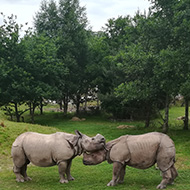
Shutterstock - Indian Rhinos at Fota Wildlife Park, Cork, Ireland.
The new arrival is a first for the country. 

A baby Indian rhino has been born at Fota Wildlife Park, in a first for Ireland.

Born to parents Maya and Jamil in September 2022, the rhino is the first Indian rhino to be born in Ireland, and the second of only three Indian rhino calves born at a zoological institution this year.

With only 3,300 Indian rhino living in the wild, the species is listed as vulnerable by the International Union for Conservation of Nature (IUCN), with the illegal trade of poaching posing the most significant threat.

Lead Ranger Aidan Rafferty commented on the exciting arrival: “Fota Wildlife Park is delighted to announce the first baby Indian rhino, hopefully, the first birth of many to come. 

“Both mother and baby are doing really well. Maya is very protective and is constantly by his side. 

“We’re delighted to see the little calf running around and playing. He is an absolutely gorgeous animal, and he’s getting stronger and more curious every day.”

With the new addition, Fota Wildlife Park is home to four Indian rhino – Maya and Jamil, a non-breeding male named Shusto, and the calf.

The one-horned Indian rhino was one widespread across parts of Asia, but population decimation meant that the species was close to extinction at the beginning of the 20th Century. 

The global Indian rhino population is now concentrated in Assam province, India, where 85 per cent of the species reside.

Ireland's first Indian rhino calf is a welcome addition to the future of the species, and the as-yet-unnamed calf will be available for visitors to the Wildlife Park to view.


 

Become a member or log in to add this story to your CPD history

Equine Disease Surveillance report released for Q4 2025

News Story 1
 The latest Equine Disease Surveillance report has been released, with details on equine disease from Q4 of 2025.

The report, produced by Equine Infectious Disease Surveillance, includes advice on rule changes for equine influenza vaccination.

Statistics and maps detail recent outbreaks of equine herpes virus, equine influenza, equine strangles and equine grass sickness. A series of laboratory reports provides data on virology, bacteriology, parasitology and toxicosis.

This issue also features a case study of orthoflavivus-associated neurological disease in a horse in the UK. 

Click here for more...
News Shorts
NSA webinar explores sheep tailing and castration

The National Sheep Association (NSA) is to host a free webinar on the castration and tail docking of lambs.

The webinar, 'Understanding the tailing and castration consultation: A guide for sheep farmers', will be hosted online on Monday, 2 March 2026 at 7.30pm.

It comes during a government consultation into the methods used for these procedures. Farmers are encouraged to engage before the consultation period closes on Monday, 9 March 2026.

The webinar offers clear and actionable guidance to support farmers to contribute meaningfully to the consultation and prepare for potential changes.

On the panel will be former SVS president Kate Hovers, farmer and vet Ann Van Eetvelt and SRUC professor in Animal Health and Veterinary Sciences Cathy Dwyer. Each panel member will utilise their own specialism and expertise to evaluate risks and outcomes to sheep farming.

Find out more about the webinar on the NSA website.

