


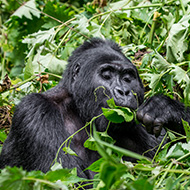
Scientists test specimens retrieved in the wild for human herpesvirus.
US vets have employed a novel technique to provide personalised health care to endangered mountain gorillas.
The team from University of California, Davis – known as the Gorilla Doctors - have been retrieving saliva-drenched chewed plants to gather vital data about the species health and rule out the presence of human herpesviruses.
Gorilla Doctors is the only organisation in the world dedicated to conserving mountain and eastern lowland gorillas through veterinary medicine, science and a One Health approach.
Their study, which took place in Rwanda, the Democratic of Congo and Uganda, is described in the American Journal of Primatology.
“We were able to do this study entirely using chewed plants, commented Tierra Smiley Evans, research faculty with the WHC and One Health Institute at UC Davis. “That allowed us to collect specimens from every known, habituated mountain gorilla in Uganda and Rwanda.
"This shows we can monitor gorillas — and potentially other primate species — over time, noninvasively, at the individual level and help answer questions regarding their conservation.”
Wild gorillas in the Uganda and Rwanda are used to humans, and gorilla trekking is a popular activity.
While this tourism encourages the preservation of their environment, it also requires a high standard of care to avoid spreading disease between humans and gorillas. A human herpesvirus may only cause a cold sore in a human, but if it spreads to gorillas or other animals, it can have more severe effects.
After extracting the DNA from the discarded plants and testing them for orally shed pathogens, the researchers found no evidence of human herpesvirus infection among the free-ranging gorillas. Their finding suggests that the work of the Gorilla Doctors and gorilla management authorities to limit distance between humans and gorillas in the park is working to mitigate the transmission of disease.
Kirsten Gilardi, DVM, executive director of the Gorilla Doctors, said the finding also serves as a reminder to stay vigilant to prevent novel viruses from entering the population.
“Gorilla Doctors research has proven that human viruses cause respiratory disease in endangered mountain gorillas,” she explained. “Dr Evans’ research findings that human herpesviruses were not detected in gorilla saliva was reassuring.
"It’s further evidence that park rules for gorilla visitation, like wearing face masks and keeping a minimum distance of 23-33 feet, are effective in reducing the risk of transmission of human diseases to mountain gorillas.”


 Defra has published guidance for the vet sector ahead of a proposed UK-EU Sanitary and Phytosanitary agreement.



