
Your data on MRCVSonline
The nature of the services provided by Vision Media means that we might obtain certain information about you.
Please read our Data Protection and Privacy Policy for details.

In addition, (with your consent) some parts of our website may store a 'cookie' in your browser for the purposes of
functionality or performance monitoring.
Click here to manage your settings.
If you would like to forward this story on to a friend, simply fill in the form below and click send.

Your friend's email:
Your email:
Your name:
 
 
Send Cancel

Reptile relinquishment could be halved with education
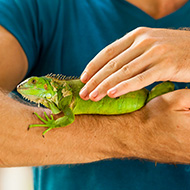
"I believe that education is a key aspect of protecting wider reptile welfare" - Helen Tedds.
Research analyses reptile adverts on classified websites.

Better education on reptile care and welfare could almost halve the number of pet reptiles being given up, new research from Hartpury University suggests.

Lecturer in Animal Welfare and academic Helen Tedds is currently undertaking research on the pet reptile trade across England, and has analysed tens of thousands of classified adverts selling reptiles in order to gain an understanding of the reasons that owners give up a pet.

Of the 20,908 reptiles advertised with a reason for sale or rehoming over the last three years, 44.6 per cent cited reasons that Tedds believes could potentially have been avoided by better education on the species.

Discussing her research, Helen said: “Reptiles, like so many other pets, can be extremely rewarding for their owners. However, they often have specialist needs when it comes to things like housing, nutrition, and enrichment.

“Rehoming reptiles can be unsettling for the animal and is often upsetting for the owner, who with the right guidance and support, may feel more confident and empowered to keep the pet and provide a good home.”

Owing to her research, Tedds has been invited to the House of Lords to discuss the launch of the new 'Pet Know How' initiative, created by the Companion Animal Sector Council.

The initiative aims to educate prospective reptile owners before they buy, allowing for greater care and welfare.

Helen commented: “Given the findings from my research, I believe that education is a key aspect of protecting wider reptile welfare and I’m very much in support of this new initiative from the Companion Animal Sector Council.”


Become a member or log in to add this story to your CPD history

Equine Disease Surveillance report released for Q4 2025

News Story 1
 The latest Equine Disease Surveillance report has been released, with details on equine disease from Q4 of 2025.

The report, produced by Equine Infectious Disease Surveillance, includes advice on rule changes for equine influenza vaccination.

Statistics and maps detail recent outbreaks of equine herpes virus, equine influenza, equine strangles and equine grass sickness. A series of laboratory reports provides data on virology, bacteriology, parasitology and toxicosis.

This issue also features a case study of orthoflavivus-associated neurological disease in a horse in the UK. 

Click here for more...
News Shorts
NSA webinar explores sheep tailing and castration

The National Sheep Association (NSA) is to host a free webinar on the castration and tail docking of lambs.

The webinar, 'Understanding the tailing and castration consultation: A guide for sheep farmers', will be hosted online on Monday, 2 March 2026 at 7.30pm.

It comes during a government consultation into the methods used for these procedures. Farmers are encouraged to engage before the consultation period closes on Monday, 9 March 2026.

The webinar offers clear and actionable guidance to support farmers to contribute meaningfully to the consultation and prepare for potential changes.

On the panel will be former SVS president Kate Hovers, farmer and vet Ann Van Eetvelt and SRUC professor in Animal Health and Veterinary Sciences Cathy Dwyer. Each panel member will utilise their own specialism and expertise to evaluate risks and outcomes to sheep farming.

Find out more about the webinar on the NSA website.

