


Just 51 per cent of homelessness services are dog friendly.
The barriers facing homeless people and their pets have been highlighted in new research published by Dogs Trust.
A survey by the charity revealed that the lack of dog-friendly accommodation is forcing people to choose between their much-loved pets and a safe place to sleep.
Of the professionals supporting the homeless that responded to the survey, 70 per cent said their clients had difficulty accessing services because they had a dog.
A further 84 per cent said they knew of at least one case in which somebody had refused an offer of temporary accommodation because it would mean giving up their dog.
Just 51 per cent of homelessness services that responded said that their services were dog friendly. The barriers seemingly extend beyond temporary accommodation too - with 75 per cent of service providers having experienced difficulties in finding dog-friendly move-on accommodation for owners they had supported.
In light of their findings, Dogs Trust is raising awareness of its Hope Project, which aims to keep homeless people and their pets together. Working closely with homelessness services, the project provides bespoke support and ongoing advice on everything from dog-friendly policies to behaviour resources.
The Hope Project also offers free veterinary care to dogs whose owners are suffering or in danger of homelessness, as well as a Christmas parcel programme where the organisation distributes dog goodies to homelessness services around the country that support dog owners.
“For most dog owners, being separated from their dog is no different from being separated from a family member," explained Harriet Page, pets and housing manager at Dogs Trust. "Many dog owners experiencing homelessness are forced to make the heartbreaking decision to give up their beloved pets just so they can have somewhere safe and secure to sleep.
"It’s clear that many people are turning down offers of accommodation as they do not want to say goodbye to their beloved pet. We don’t think anyone should have to choose between a bed or their faithful friend. Through our Hope Project, we work with many temporary housing providers who successfully offer dog-friendly accommodation."
"I feared we would end up sleeping on the streets"
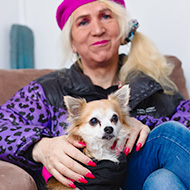
One dog owner who faced barriers to finding somewhere to live with her four-legged friend is Nicky. Nicky was given just days to vacate her property and struggled to find a privately rented place that would accept dogs.
Thankfully, leading homelessness charity St Mungo’s stepped in to help, and she now lives in one of its hostels in South London with her pet chihuahua, Foxy.
Nicky said: "I feared we would end up sleeping on the streets. St Mungo’s came along and offered us a space in a hostel, it was a great weight off my mind.
“Foxy was my only companion during lockdown, he was my only friend. The only time I went out was to walk him. Having a dog gives you a responsibility, an aim or a goal. When I was depressed I couldn’t be bothered getting up, but having a dog jumping up and down and needing something gave me a reason to get up in the morning.
“It was nerve-wracking going into the hostel but everyone was really nice, and Foxy got showered with attention. There’s no way I could have left him behind, he is like a child to me.”
"We recognise the powerful emotional support pets can provide"
Sylvia Tijmstra, St Mungo’s Head of Westminster Services, said: “We know that pets can sometimes feel like the only companion for people who are sleeping rough. They provide warmth and comfort when people need it most. At St Mungo’s we recognise the powerful emotional support pets can provide, and that’s why we are one of the only charities to accept pets in our hostels.
“Without pet friendly charities like St Mungo’s and Dogs Trust, many more people would be faced with having to choose between a safe place to sleep and keeping their pet. So we at St Mungo’s feel that it’s vital we provide support for people and their pets to help end homelessness.”
Image (C) Dogs Trust.


 BVA has announced a new series of its Building Great Workplaces lunchtime webinars.



