
Your data on MRCVSonline
The nature of the services provided by Vision Media means that we might obtain certain information about you.
Please read our Data Protection and Privacy Policy for details.

In addition, (with your consent) some parts of our website may store a 'cookie' in your browser for the purposes of
functionality or performance monitoring.
Click here to manage your settings.
If you would like to forward this story on to a friend, simply fill in the form below and click send.

Your friend's email:
Your email:
Your name:
 
 
Send Cancel

Cats Protection identifies rare kitten of 'neither sex'
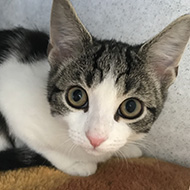
Pictured: Hope - now named Beans.

The charity had never come across the condition before.

A kitten, taken in by Cats Protection, has surprised its carers and vets after it was found that they could not be deemed male or female.

Brought into Cats Protection Warrington, and later transferred to the charity's Tyneside Adoption Centre, the cat – named Hope by the Cats Protection team – did not have any external sex organs.

After further inspection, it was found that they had no sex organs, externally or internally.

Fiona Brockbank, Cats Protection's senior field veterinary officer, explained: “We carried out a procedure to look for sex organs but there’s nothing apparent inside or out. There’s an outside possibility of some ectopic ovarian tissue hiding away internally but we think this is extremely unlikely.

“This is so rare that there isn’t really a commonly used term for this condition, but it is effectively ‘sexual organ agenesis’ – where agenesis is the lack or failure of development in relation to body organs.”

Cats with both male and female sex organs, known as hermaphrodite cats, are also incredibly rare. Hope, however, is an even rarer case.

“This is not something we’ve come across before at Cats Protection,” Fiona continued.

“While this means we don’t have any previous cases to base our knowledge of how this will affect Hope in the future, we spent time monitoring this cat to ensure they can urinate and defecate appropriately before they were considered ready for rehoming.”

Staff and volunteers at the charity have commented on 15-week-old Hope's playful nature, and Beni Benstead, Tyneside centre manager, said: “Discovering Hope’s special status has been an exciting time as none of us have seen this before or are likely to again.”

After confirming that Hope is a happy and healthy kitten, they were able to be adopted. Renamed Beans, the kitten has now found their forever home. 


Image (C) Cats Protection

Become a member or log in to add this story to your CPD history

Equine Disease Surveillance report released for Q4 2025

News Story 1
 The latest Equine Disease Surveillance report has been released, with details on equine disease from Q4 of 2025.

The report, produced by Equine Infectious Disease Surveillance, includes advice on rule changes for equine influenza vaccination.

Statistics and maps detail recent outbreaks of equine herpes virus, equine influenza, equine strangles and equine grass sickness. A series of laboratory reports provides data on virology, bacteriology, parasitology and toxicosis.

This issue also features a case study of orthoflavivus-associated neurological disease in a horse in the UK. 

Click here for more...
News Shorts
NSA webinar explores sheep tailing and castration

The National Sheep Association (NSA) is to host a free webinar on the castration and tail docking of lambs.

The webinar, 'Understanding the tailing and castration consultation: A guide for sheep farmers', will be hosted online on Monday, 2 March 2026 at 7.30pm.

It comes during a government consultation into the methods used for these procedures. Farmers are encouraged to engage before the consultation period closes on Monday, 9 March 2026.

The webinar offers clear and actionable guidance to support farmers to contribute meaningfully to the consultation and prepare for potential changes.

On the panel will be former SVS president Kate Hovers, farmer and vet Ann Van Eetvelt and SRUC professor in Animal Health and Veterinary Sciences Cathy Dwyer. Each panel member will utilise their own specialism and expertise to evaluate risks and outcomes to sheep farming.

Find out more about the webinar on the NSA website.


