


Water flow rate affects survival of fish offspring
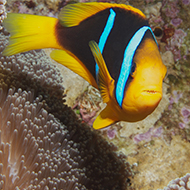
The research is an international collaboration between CRIOBE and the University of Glasgow.
The body shape and survival of fish offspring is affected by the water flow where the adult fish live, a new study has revealed.
A collaboration between the Centre of Island Research and Environmental Observatory (CRIOBE) and the University of Glasgow has found that the survival rate of fish born from parents living under high water flow is 55 per cent lower compared to fish born from parents living under low water flow.
Researchers studied the offspring of orange-fin anemonefish (Amphiprion chrysopterus) from a wild population in Moorea. Fish living under high water flow had offspring that had distinctive fin shapes – an 18 per cent greater caudal fin shape than those living under low water flow.
Daphne Cortese, postdoctoral researcher at the University of Glasgow, who carried out her PhD at CRIOBE, explained: “On coral reefs, water flow varies between sites, as well as over time.
“To cope with these varied water flows, fish may present differences in the shape, size and dimensions of their fins and body, as well as in their swimming ability and metabolism.
“However, until now, we’ve not known to what extent these trait differences come from their parents and the environment in which their parents live; via genes or differences the parents have passed on; or if the water flow in which offspring develop determines their traits.”
The water flow does not only impact body shape, but fundamentally, it impacts the survival rate of offspring. The offspring with parents living under high water flow had a survival rate reduced by half in comparison to those with parents living under low water flow.
Ricardo Beldade, Centre National de Recherche Scientifique (CRNS) at CRIOBE, said: “Overall, these findings suggest consequences of living in different environments with likely compromises between parents and offspring traits and survival in wild populations.”
The study has been published in Functional Ecology.


 Defra has published guidance for the vet sector ahead of a proposed UK-EU Sanitary and Phytosanitary agreement.



