


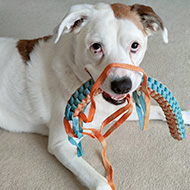
The boxer-cross was given a two per cent chance of survival.
A boxer cross has overcome the odds to defeat a rare tumour thanks to a team of veterinary specialists in Somerset.
Nine-year old Daisy was referred to Cave Veterinary Specialists after drinking excessively and later experiencing a 20-second seizure. The team identified the problem as an adrenal mass, which was successfully removed by Cave's head of surgery, Malcolm Jack.
The surgery was particularly remarkable given that Daisy's local veterinary practice said that while they could conduct the operation, her chances of survival would only be two per cent. However, under the specialist care of Cave, its state-of-the-art equipment and expert team, her chances were increased to 80 per cent.
Malcolm said: “Daisy was cared for by five different disciplines at the hospital - medicine, imaging, anaesthesia, surgery and nursing. She had complete blood count and biochemistry, urinalysis, thoracic radiographs and an abdominal ultrasound which identified an adrenal mass.
“Further blood tests were performed to try and find out the type of mass, including an ACTH stimulation test, a low dose dexamethasone suppression test and the measurement of plasma metanephrines. We then carried out a CT scan to better assess the extent of the mass and to investigate if it was invading the caudal vena cava, the large venous vessel in the abdomen which takes blood to the heart.
“Finally, I operated to remove the adrenal tumour. It is a challenging surgery typically performed at referral practices, and in this case, it required the mass being carefully dissected off a long length of the caudal vena cava.”
Daisy recovered well under the supervision of Cave's nursing team and was soon allowed home, much to the relief of her owner, Sally Harper, from Devon.
Sally said: “I must admit there were plenty of tears when we left her at Cave for the operation as we knew it was a rare condition and it would be very difficult surgery. It was amazing when we got the news that Daisy had come through the operation and all the mass had been successfully removed.”
Image (C) Cave Veterinary Specialists.

 BVA has announced a new series of its Building Great Workplaces lunchtime webinars.



