
Your data on MRCVSonline
The nature of the services provided by Vision Media means that we might obtain certain information about you.
Please read our Data Protection and Privacy Policy for details.

In addition, (with your consent) some parts of our website may store a 'cookie' in your browser for the purposes of
functionality or performance monitoring.
Click here to manage your settings.
If you would like to forward this story on to a friend, simply fill in the form below and click send.

Your friend's email:
Your email:
Your name:
 
 
Send Cancel

London Zoo's annual stocktake gets underway
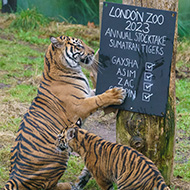
The zoo welcomed two Sumatran tiger cubs named Zac and Crispin in 2022.

Pygmy goats and Sumatran tiger cubs are among the attraction's latest arrivals.

Keepers at ZSL London Zoo dusted off their cameras, clipboards and calculators on Tuesday (3 January) for their New Year stocktake.

From Sumatran tigers to Pygmy goats, the Regents Park team counted up more than 300 different species during the attraction's annual audit.

2022 saw the arrival of many new animals at the zoo, from a critically endangered Western lowland gorilla named Kiburi to two Sumatran tiger cubs named Zac and Crispin.

Ten Humboldt penguin chicks hatched on penguin beach, while pygmy goats Chestnut, Buttons and Truffle joined the herd in June.

Dan Simmonds, ZSL’s zoological operations manager, said: “With more than 14,000 to count at ZSL London Zoo, our keepers all have their own ways of tallying up the animals in their care – from taking pictures of the coral tank in Tiny Giants to avoid counting the same fish twice, to using training and rewards to count larger groups such as our squirrel monkeys and Humboldt penguins.”

Also featuring in the count for the first time is big-headed turtle Celia, whose parents were rescued from the illegal wildlife trade. Celia will soon move with 1,339 other reptiles and amphibians to an exciting new home, The Secret Life of Reptiles and Amphibians, opening in the Spring. 

For some zookeepers, counting the animals is as simple as 1-2-3, but others come up with ingenious strategies to ensure every animal at the Zoo is accounted for. For example, the Tiny Giants team counts ant colonies as a single entity rather than counting hundreds of individual ants, while the herpetologists take photographs of the tadpole tank to help complete their count. 

Information from the audit will be shared with other zoos around the globe via a database called ZIMS, used to help manage worldwide conservation breeding programmes for endangered species. 

Image (C) ZSL London Zoo.

Become a member or log in to add this story to your CPD history

Equine Disease Surveillance report released for Q4 2025

News Story 1
 The latest Equine Disease Surveillance report has been released, with details on equine disease from Q4 of 2025.

The report, produced by Equine Infectious Disease Surveillance, includes advice on rule changes for equine influenza vaccination.

Statistics and maps detail recent outbreaks of equine herpes virus, equine influenza, equine strangles and equine grass sickness. A series of laboratory reports provides data on virology, bacteriology, parasitology and toxicosis.

This issue also features a case study of orthoflavivus-associated neurological disease in a horse in the UK. 

Click here for more...
News Shorts
NSA webinar explores sheep tailing and castration

The National Sheep Association (NSA) is to host a free webinar on the castration and tail docking of lambs.

The webinar, 'Understanding the tailing and castration consultation: A guide for sheep farmers', will be hosted online on Monday, 2 March 2026 at 7.30pm.

It comes during a government consultation into the methods used for these procedures. Farmers are encouraged to engage before the consultation period closes on Monday, 9 March 2026.

The webinar offers clear and actionable guidance to support farmers to contribute meaningfully to the consultation and prepare for potential changes.

On the panel will be former SVS president Kate Hovers, farmer and vet Ann Van Eetvelt and SRUC professor in Animal Health and Veterinary Sciences Cathy Dwyer. Each panel member will utilise their own specialism and expertise to evaluate risks and outcomes to sheep farming.

Find out more about the webinar on the NSA website.


