


Invasive rats change behaviour of reef fish
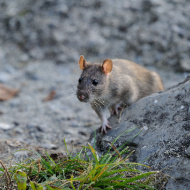
It is thought that the rats arrived on the island as stowaways on ships in the 1700s.
A new study has revealed that invasive rats are affecting the territorial behaviour of fish on coral reefs surrounding tropical islands.
Studying five rat-infested islands and five rat-free islands in a remote island archipelago in the Indian Ocean, scientists found that the presence of rats changed the behaviour of the jewel damselfish living in the surrounding coral reefs.
Led by Dr Rachel Gunn, the research team discovered that the rats disrupted an important nutrient cycle on the islands. The rats attack and eat the small resident seabirds and their eggs, which greatly reduces the population of these animals on the island.
The seabirds are a necessary part of the damselfish nutrient cycle, as they return to nest on islands, depositing nutrients through their droppings on the island. These are then washed into the sea and fertilise the coral reef ecosystems.
Published in Nature Ecology and Evolution, the study shared that on rat-infested islands, 251 times less nitrogen flowed onto the surrounding coral reefs, lowering the nutrient content of the seaweed.
Around the islands without rat infestations, the damselfish were found to be significantly more aggressive, with smaller territories to protect their food source. Those on reefs near to the rat-infested islands were much less aggressive.
Dr Gunn explained the behaviour in ScienceDaily: “Jewel damselfish around rat-free islands aggressively defend their turf because the higher enriched nutrient content means they get 'more for their money', and this makes it worth the energy cost needed to defend.
“Conversely, the fish around rat-infested islands behave less aggressively. We believe that the presence of rats is lowering the nutritional benefit of the turf to the extent that it is almost not worth fighting for, which is what we are observing with these behaviour changes.
"The algal farming of damselfish affects the balance of corals and algae on the reef. Their aggression towards other fish can influence the way those fish move around and use the reef.
“We do not yet know what the consequence of this behavioural change will be but ecosystems evolve a delicate balance over long time-scales, so any disruption could have knock-on consequences for the wider ecosystem.”


 Defra has published guidance for the vet sector ahead of a proposed UK-EU Sanitary and Phytosanitary agreement.



