
Your data on MRCVSonline
The nature of the services provided by Vision Media means that we might obtain certain information about you.
Please read our Data Protection and Privacy Policy for details.

In addition, (with your consent) some parts of our website may store a 'cookie' in your browser for the purposes of
functionality or performance monitoring.
Click here to manage your settings.
If you would like to forward this story on to a friend, simply fill in the form below and click send.

Your friend's email:
Your email:
Your name:
 
 
Send Cancel

Dogs sought for autoimmune disease study
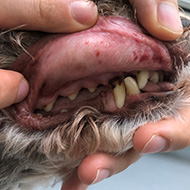
‘Petechiae’ - a dog with immune mediated thrombocytopenia showing oral petechiae (oral small, pintpoint bleeding).

The RVC-led project aims to improve canine wellbeing. 

Pet owners of dogs with autoimmune diseases are being invited to take part in a study to improve the wellbeing of those diagnosed in the future.

The study is being led by Drs Barbara Glanemann and James Swann at the RVC, who have created an observational registry to gather information about dogs recently diagnosed with autoimmune disease.

The ‘ImmunoRegistry’ data will be collected in real-time over a year after diagnosis to find out how the dogs respond to treatment.

Dr Glanemann explained: “We are looking to observe as many dogs as possible so that we can examine the data and ultimately share more informed advice and guidance with vets, and in turn, owners.

“This ambitious project relies on the enthusiasm and support of dog owners, and we look forward to using our results to improve the wellbeing of any dog diagnosed with immune-mediated disease in the future.”

The observational registry will collect data on dogs diagnosed in local practices and specialist hospitals. Researchers will then use the information to examine the prognosis associated with the diseases, if there are risks or relapse and whether medication works better in certain dog breeds. 

In particular, the team is seeking dogs diagnosed with IMHA, ITP, IMPA or SRMA. To meet the criteria, pet owners should:

  • be UK based 
  • register their interest and consent to participate in the study within 14 days of their dog receiving a diagnosis of one of the above conditions
  • be willing to fill out six, five-minute surveys on the quality of life of their dog over 12 months following diagnosis.

For more information and to register your interest, visit rvc.onlinesurveys.ac.uk/immunoregistry


Image (C) RVC.

Become a member or log in to add this story to your CPD history

Vets launch new podcast for pet owners

News Story 1
 Two independent vets have launched a podcast to help owners strengthen their bond with pets. Dr Maggie Roberts and Dr Vanessa Howie, who have worked in both veterinary practice and major charities, are keen to use their experience to enable people to give pets a better life.

The venture, called Vets Talking Pets, provides advice and information on a range of topics, including how to select a suitable pet, where to obtain them and how to get the best out of your vet. Maggie and Vanessa will also discuss sensitive subjects, including end-of-life care, raw food diets and the cost of veterinary care.

The podcast can be found on all the usual podcast sites, including Podbean, Apple, Amazon Music and YouTube. 

Click here for more...
News Shorts
VMD issues guidance on AVM-GSL packaging

The Veterinary Medicines Directorate (VMD) has shared advice on its requirements for medicines considered AVM-GSL.

The guidance explains the information that should be on the outer package, and sets out the typical maximum pack size for an AVM-GSL product. It also describes the user-friendly language, structure and phrases required on packaging and product leaflets.

AVM-GSL products do not require discussion between the purchaser and a veterinary professional. This means that clear product information is needed to support sales choices.

The information will be useful for submitting new products to the AVM-GSL category and lowering the distribution category of products from NFA-VPS to AVM-GSL.

The VMD's guidance can be accessed here.


