
Your data on MRCVSonline
The nature of the services provided by Vision Media means that we might obtain certain information about you.
Please read our Data Protection and Privacy Policy for details.

In addition, (with your consent) some parts of our website may store a 'cookie' in your browser for the purposes of
functionality or performance monitoring.
Click here to manage your settings.
If you would like to forward this story on to a friend, simply fill in the form below and click send.

Your friend's email:
Your email:
Your name:
 
 
Send Cancel

London Zoo welcomes two spiky bundles of joy
The porcupettes have spent their first week snuggling up to mum.

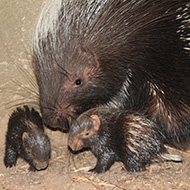
Porcupettes Hector and Hinata are bonding with their new family.

ZSL London Zoo has announced the arrival of two baby Cape porcupines – known as porcupettes.

Born in January to parents Hettie and Henning, the pair are said to be confidently exploring their new surroundings.

Cape porcupines are classed as a species of 'least concern' on the IUCN Red List, but they increasingly face the threats of habitat destruction and hunting. 

Following the birth, zookeepers named the male and female duo Hector and Hinata, keeping with the trend to name all porcupines in the family with a letter starting with H. They join siblings nine-month-old Hershey and five-month-old Henry.

Keeper Veronica Heldt, who first discovered the duo on the Zoo's porcupine-cam, said they “are developing really well” and “bonding well with their new family”. 

The twins weigh a healthy 660g and 750g and have spent their first week snuggling up to mum in their cosy indoor den. 

Veronica said: “Thankfully for mum Hettie, baby porcupines are born with short, soft quills that harden at about one week of age, so labour wasn’t as painful as people might imagine!”

Native to central and southern Africa, Cape porcupines are considered 'ecosystem engineers' thanks to their expertise in foraging and digging. They are the largest 
porcupine species and Africa’s second-largest rodent.

Image (C) ZSL London Zoo.

Become a member or log in to add this story to your CPD history

Equine Disease Surveillance report released for Q4 2025

News Story 1
 The latest Equine Disease Surveillance report has been released, with details on equine disease from Q4 of 2025.

The report, produced by Equine Infectious Disease Surveillance, includes advice on rule changes for equine influenza vaccination.

Statistics and maps detail recent outbreaks of equine herpes virus, equine influenza, equine strangles and equine grass sickness. A series of laboratory reports provides data on virology, bacteriology, parasitology and toxicosis.

This issue also features a case study of orthoflavivus-associated neurological disease in a horse in the UK. 

Click here for more...
News Shorts
NSA webinar explores sheep tailing and castration

The National Sheep Association (NSA) is to host a free webinar on the castration and tail docking of lambs.

The webinar, 'Understanding the tailing and castration consultation: A guide for sheep farmers', will be hosted online on Monday, 2 March 2026 at 7.30pm.

It comes during a government consultation into the methods used for these procedures. Farmers are encouraged to engage before the consultation period closes on Monday, 9 March 2026.

The webinar offers clear and actionable guidance to support farmers to contribute meaningfully to the consultation and prepare for potential changes.

On the panel will be former SVS president Kate Hovers, farmer and vet Ann Van Eetvelt and SRUC professor in Animal Health and Veterinary Sciences Cathy Dwyer. Each panel member will utilise their own specialism and expertise to evaluate risks and outcomes to sheep farming.

Find out more about the webinar on the NSA website.


