


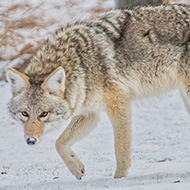
New study suggests the ability is not unique to domestic dogs.
A new study has suggested that coyotes can make “puppy dog eyes”, challenging the idea that the trait is unique to domestic dogs.
Scientists at Baylor University examined the muscle responsible for raising the inner eyebrow – the levator anguli oculi medialis (LOAM) – in coyotes, and found that it is almost identical to that found in dogs.
The finding contradicts the idea that the muscle developed specifically to enable communication between humans and dogs during domestication.
Patrick Cunningham, who led the research team, said: “Our findings suggest that the ability to produce ‘puppy dog eyes’ is not a unique product of dog domestication but rather an ancestral trait shared by multiple species in the Canis genus. This raises fascinating questions about the role of facial expressions in communication and survival among wild canids.”
In the study, published in the Royal Society Open Science, researchers compared the facial muscles of dogs, coyotes, and gray wolves. They found that whilst the LAOM is well-developed in coyotes and dogs, the muscle is either absent or modified in gray wolves.
The current hypothesis suggests that the LAOM developed to enable humans and dogs to communicate with each other. However, this new finding suggests the muscle was likely present in a common ancestor of coyotes, dogs, and gray wolves but was later lost or reduced in wolves.
Furthermore, the study highlights significant differences in the facial muscles of coyotes, especially those related to lip and brow movements. A DNA test ruled out significant dog ancestry in the coyote specimens, supporting the idea that these traits are not a result of crossbreeding.
Cunningham said: “Our work reveals that coyotes and dogs share not just behavioral similarities, but also a fascinating evolutionary history that includes the ability to make expressions that we once thought were unique to domesticated animals”.
Image (C) Shutterstock.


 Defra has published guidance for the vet sector ahead of a proposed UK-EU Sanitary and Phytosanitary agreement.



