


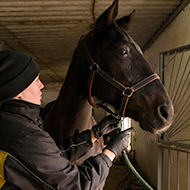
Almost two-thirds of horses showed improvement after treatment.
Electroacupuncture shows promise for treating equine trigeminal nerve-mediated headshaking (TMHS), a condition that causes uncontrollable and involuntary head shaking in horses, according to a new study.
Researchers at the Royal Veterinary College (RVC) reviewed records of 42 horses treated for TMHS with electroacupuncture between 2015 and 2024. The data included patient profiles, TMHS history, severity and outcomes perceived by the owners or primary vet.
Their findings reveal that the treatment was well tolerated by all horses, with the median headshaking significantly reduced from grade three to one. Overall, there was an improvement in 64 per cent of cases, with 33 per cent showing complete resolution.
There was no improvement in 31 per cent of cases, and 4.8 per cent (two horses) experienced worsening symptoms. The team concluded that, overall, electroacupuncture was well tolerated with minimal complications arising.
Study lead Bettina Dunkel, head of equine and professor in equine internal medicine, emergency and critical care at the RVC, said: “Electroacupuncture is a viable treatment option for horses suffering from this devastating disease. We are very pleased with the results of the study and hope that it will encourage veterinarians and horse owners to pursue this treatment option.”
TMHS is an extremely painful condition for horses that can make it dangerous for them to be ridden. There is currently no cure and, in the most extreme cases, horses may be euthanised.
Electroacupuncture uses needles and an electric current to alter pain perception in the nerve. The treatment is beneficial in that it has a low complication rate and it can be carried out in the yard.
The study, Electroacupuncture as a treatment for suspected trigeminalnerve-mediated head-shaking in 42 horses, is published in Equine Veterinary Education.
Image © Shutterstock


 Defra has published guidance for the vet sector ahead of a proposed UK-EU Sanitary and Phytosanitary agreement.



